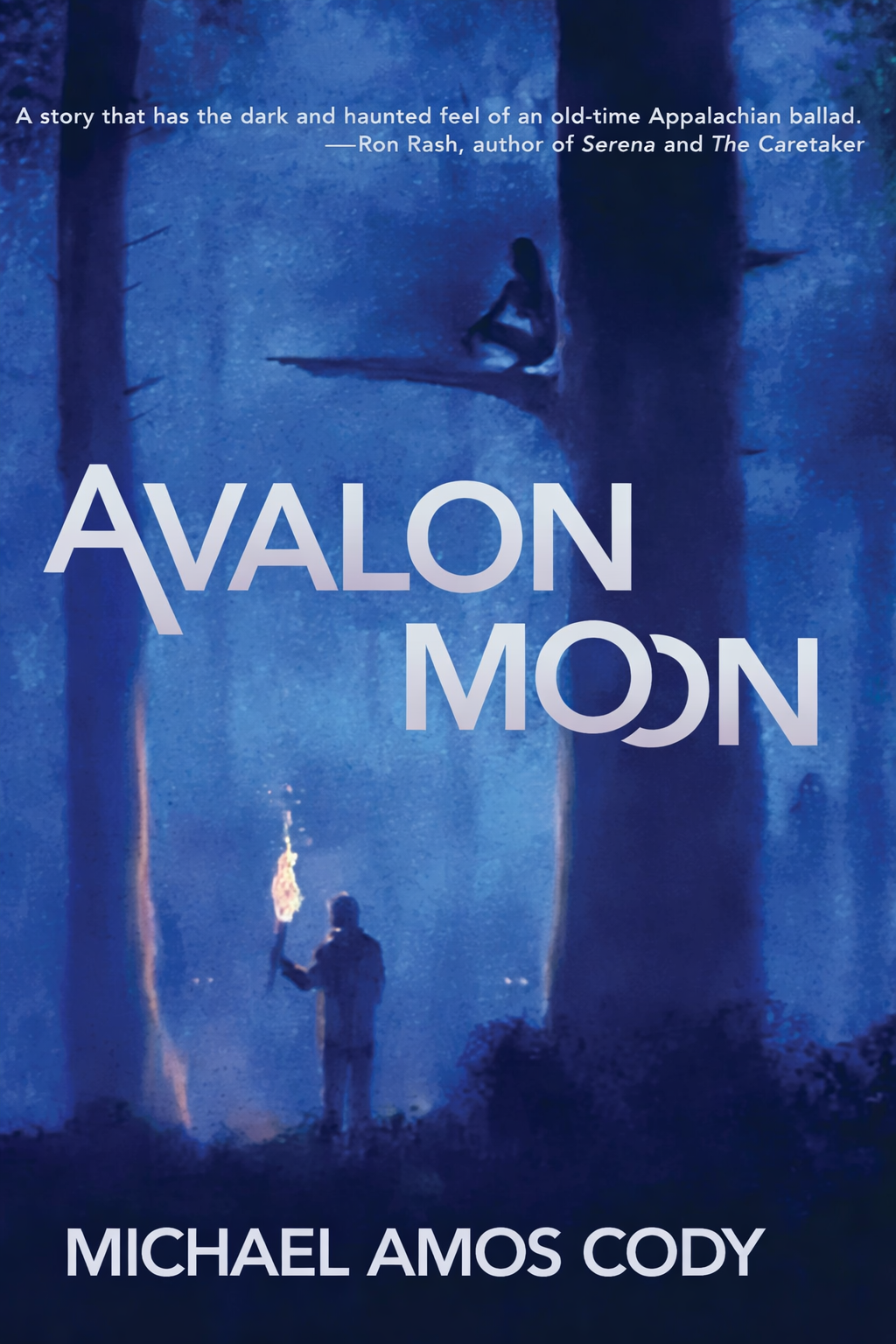
In the never-ending pursuit of shameless self-promotion, I here take advantage of messages my friends have sent me about their experiences reading Avalon Moon. . . .
Whiskey is a fine and funny author, a highly trusted reader, and a longtime friend. I’ll out him here because he asked for it — that is, he agreed to read the novel ahead of its release and blurb it for me.
I’ll leave the following reader comments anonymous:
I’m reading it now but I can only read it in daylight so it’s taking me a while. (Reply from another reader: I was the same way. Glad I kept on reading it. Brilliant book!)
Just finished the book today. A truly excellent read!
Just finished “Avalon Moon“.. Another awesome book. Couldn’t put it down once I started reading!!!
Michael Cody the book is fantastic! I loved the others but this might be my favorite. Bravo my friend! I look forward to sharing it. You need to read these for audible. As I read I can hear your voice instead of my own.
I just finished Avalon Moon. What a story! I think it is your best one yet. I certainly have no training as a critic, but I thought it was so well written. I loved the characters of Libby and Ariel, and thank you for including a goddess!! I loved the use of the lost manuscript. . . . I once participated in a meditation with a group of women on the night of the Harvest Moon. Just before we went out for a walk on our own one of the women said that she could sense an evil presence and encouraged us to be careful. I did not sense that, but it is so interesting to know that some people do. Sorry for making this so long. I really just wanted to tell you that I throughly enjoyed the book. 😊
As I read the last half of Avalon Moon, I kept getting the same feeling I got when I walked to the rim of the Bryce Canyon Amphitheater…WOW!
I absolutely loved the novel. I don’t even know where to begin … I admired both the artistry and the craft. The mythology, legends and southern mountain folklore all seamlessly served the story. The first person voices were authentic and so well done. The relationships and the characters were deeply satisfying. The alternating smaller plots weaving together into the larger plot was very enjoyable. . . . I am not well read in the gothic genre, but I loved it! I kept thinking of our late night Moores Ln conversations, and wanting to talk about the book the way we did about art, literature and your songs. . . . My heartfelt congratulations on your achievement.
Loved, loved, loved it. Your character development is top tier! And seeing the similarities between your characters and “real life” were a lot of fun. I HIGHLY recommend (and not just because I’m your friend—I’m an avid reader of all things GOOD.)
This read certainly challenged me but it was a great challenge and i really enjoyed it!
I’ll stop there on this two-month anniversary of the pub date of Avalon Moon!
Back yonder in the days of COVID, I ran across a Facebook group called “Dark Sire,” which was, as I recall (and as I understood it), connected to a publishing venture devoted to the Gothic, as that term is variously defined.
During the period that Dark Sire was active and I was following along, an artist named Shaun Power regularly posted electronic images of his paintings. I loved pretty much everything he posted and communicated with him a bit via comments on this piece or that. He was always both generous and appreciative in his responses. His work was most often dark (but rarely monstrous or terrifying) and randomly whimsical. No matter what he posted, far more often than not it resonated with me in some way.
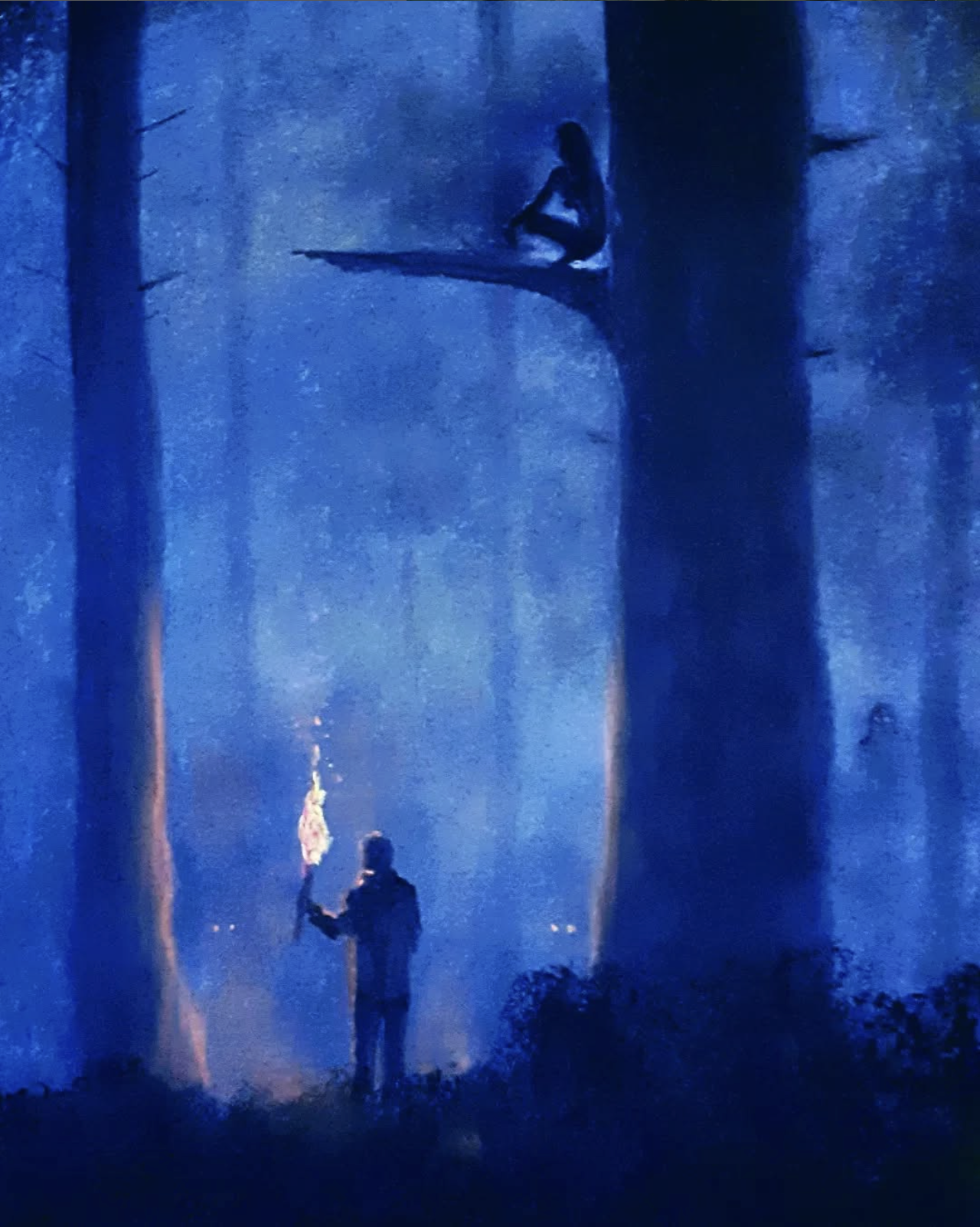
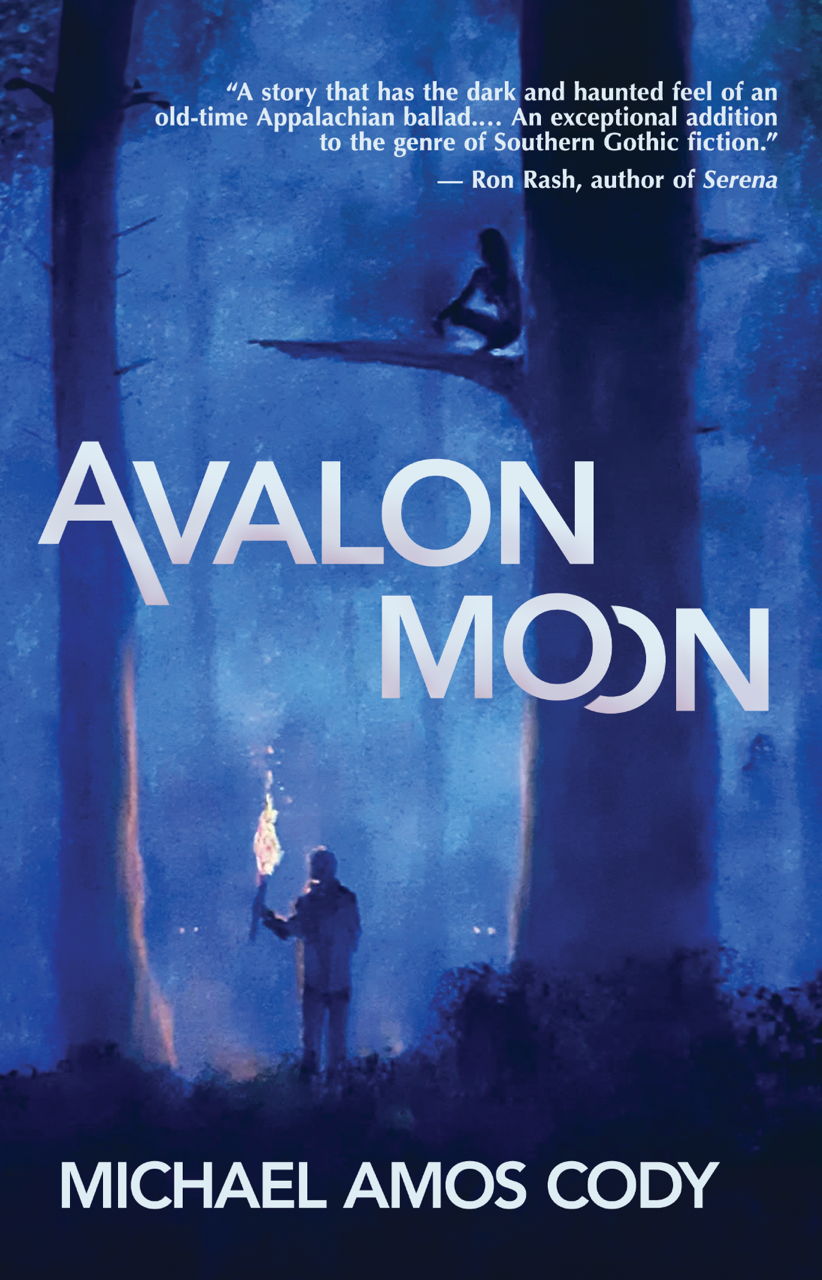
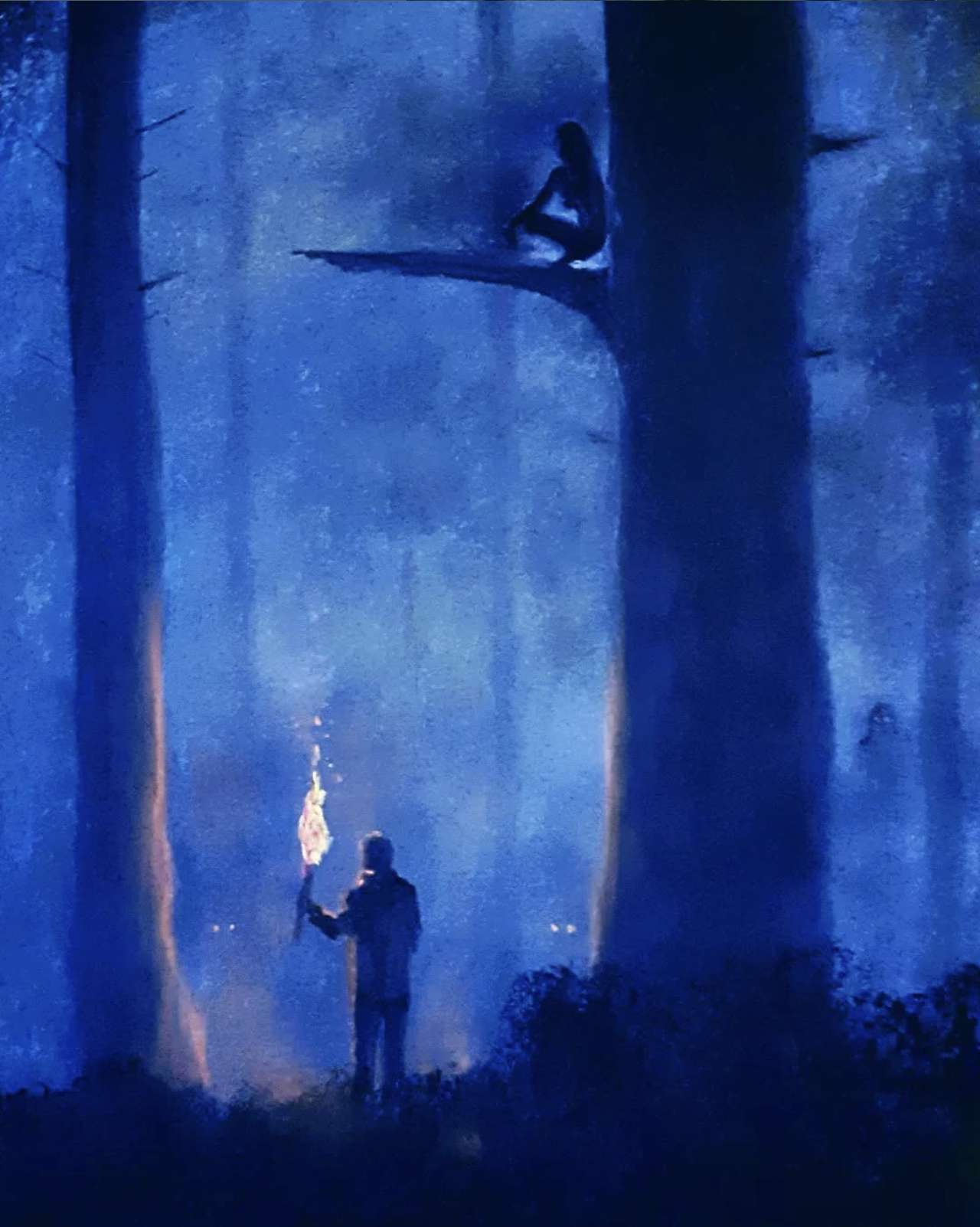
One particular painting appeared in a couple of variations and with a few different names. Here’s the version of it that spoke to me the most:
I don’t remember what title this initially appeared under, but I was immediately taken with it – particular shades of blue that are my favorites, the lonely man with the torch (maybe the torch representing desire, as in “carrying the torch” for somebody or something), the eyes of beasts glowing in the darkness, the human beast that haunts the right side of the image, the haunting silhouette of a woman on the broken branch above the lonely man (possibly what he’s looking for with that torch).
At the time I ran across Shaun’s post of this image, I was somewhere early in the process of drafting Avalon Moon. One character physically absent from the story but still a strong presence is named Kayla Logan Reeves. She’s a painter and an elementary school art teacher. Even though she has disappeared by the time the Avalon Moon story begins, I imagined this as the final canvas she worked on. (You can read about Kayla in her younger days in “Jamboree” and/or listen to the same via her song “Jamboree,” which came before the story.)
Anyway, I was so taken with Shaun Power’s painting that I wrote it into my novel as Kayla’s painting (with a couple of story-related adaptations).
Flash forward to fall 2025 when Madville Publishing emailed to ask if I had any ideas for the cover. I sent a handful of images, one of which was Shaun’s. It’s the one I wanted, and it turned out to be the one Madville liked.
We needed Shaun Power’s permission to use his artwork for my novel’s cover, so I immediately set out (virtually) to track him down. After only a few minutes I learned, sadly, that Shaun had walked on from this world in summer 2024. He was basically the same age I am, only a year or so older, so to learn of his death was made more heartbreaking in that he was so young – as I define young from this vantage point of being sixty-seven years old.
After sitting with that loss for a few minutes, I started looking again, hoping to find next of kin who might be interested in granting permission to use the image. I found his wife, now widowed, and his son, both of whom had points of contact but neither of whom seemed to have a very active online life. I wrote a note to each of them, expressing my condolences for their loss and letting them know of my interest in using one of Shaun’s paintings for my book cover. Given their low-level online activity, I didn’t expect to hear back from either.
But I think it was less that thirty minutes before his son got in touch with me and said that he and his mum thought Shaun would love having his work appear on the cover of Avalon Moon, work he was proud to have shared with Dark Sire. Because Shaun published this image under a couple of different titles, his wife and son asked that we credit it as Shaun’s Strange Land, which is a variation of one title he gave it.
Now the book is a reality, and as I’ve been posting images of it in hopes of garnering preorders (release date is May 19), most everybody who has commented on those posts express some variation of “Wow, what a cover!” I’ve sent copies to Shaun’s family in England, and I hope they’ll be as pleased with the outcome as I am. His son Wayne responded to my note telling him the books were on the way with a note including this: “My mum was only saying, earlier today, that Dad would have been like a kid waiting for Xmas until the book arrived for him to read.”
BLURB:: a short publicity notice (as on a book jacket) BLURBING : the act of writing a blurb for a book release BLURBERS : unlikely to be a real word (I think it’s made up)
Avalon Moon officially rises on May 19, 2026, when, by the way, our moon will be early in its waxing crescent phase.
A few months ago, I reached out to some writers whose work I admire—some I know personally, some I barely know, and some I don’t know—and asked if they would consider reading an advance copy of the novel and perhaps blurbing it. I can’t tell you how pleased I was that most agreed and provided the good words below.
Andrew K. Clark, author of Where Dark Things Grow: “A deliciously gothic tale stitched into a brutal murder mystery. As a serial killer stalks the mountains of North Carolina, Cody’s precise language shifts effortlessly like light through the trees – from lush gothic poetry to gritty Appalachian realism. Facing ancient gods and hungry beasts in the deep woods, the reader can’t help but dread a darker truth: evil is only ever a breath away.”
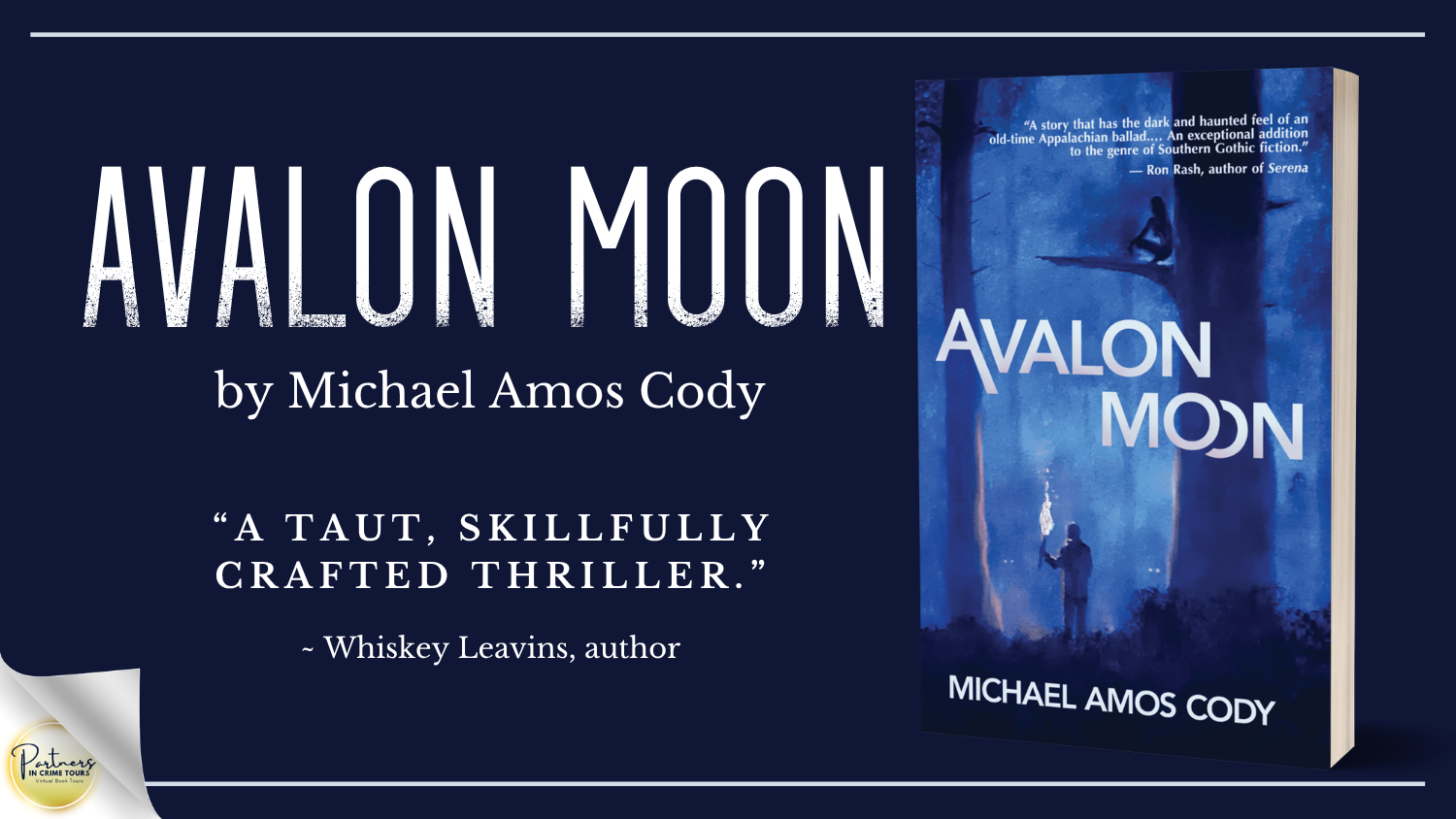
Whiskey Leavins, author of The Busker War: “A crime novel featuring a new entry to the list of Most Bone-Chilling Fictional Serial Killers ever committed to paper. Or to e-book. Whatever. The influence of Poe and Hawthorne, at their bone-chilling creepiest, can be felt egging on the unfolding of the story, one eerie development after another. A taut, skillfully crafted thriller.”
Bobby Mathews, author of Living the Gimmick: “Avalon Moon relies on vivid, inviting storytelling and precise language to lure you in, and once you’re caught in Cody’s prodigious literary talents, it’s hard to escape. . . . A book you’ll think about long after you’ve finished the story on the page.”
Peter McDade, author of King Cal: “The Appalachian town of Runion is threatened by a serial killer, wolves, and ghosts—literal and figurative—in Michael Amos Cody’s propulsive new novel, Avalon Moon. The tension and constant sense of danger kept me turning the pages, but the heart of the book is the large cast of believable characters. All are rendered with insight, compassion, and humor, and they continued to linger in my thoughts long after the novel’s satisfying conclusion.”
Mark Powell, author of Lioness: “A richly atmospheric crime novel set in the mountains of western North Carolina. Calling to mind the early Appalachian work of Cormac McCarthy cut with the chill of Stephen King. . . . A beautifully written thriller that immerses readers in a world where the landscape is as compelling and enigmatic as the killer they seek.”
Ron Rash, author of The Caretaker: “A story that has the dark and haunted feel of an old-time Appalachian ballad. Literary echoes of writers such as Samuel Taylor Coleridge and Charles Brockden Brown add to the novel’s richness and make Avalon Moon an exceptional addition to the genre of Southern Gothic fiction.”
Cathy Rigg, author of That Which Binds Us: “A delicious slice of Appalachian Gothic, filled with mystery and intrigue, and layered with a compelling cast of characters, malevolent to endearing. Rich with mountain folklore and a centering nod to Artemis, Goddess of the Hunt, Cody’s novel is a page-turning who-done-it you’ll find yourself flying through. But do slow down. Breathe! There are so many tasty layers, and you’re gonna want to savor every bite.”
Charles Dodd White, author of In the House of Wilderness: “Michael Amos Cody delivers a thrilling and tense Appalachian noir in his latest novel Avalon Moon. By turns suspenseful and evocative, this story of a killer on the loose will keep you up at night. Deftly written, with a sharp ear for dialogue and a faultless sense of place, Cody affirms his position as one of the most exciting writers of crime fiction in Appalachia today.”
Coming Next Week: A few words on this wonderful artwork on the cover!
Recently, I received word that Streets of Nashville was named a 2025 Finalist at BestThrillers.com. Very gratifying! I don’t know if the same might happen to Avalon Moon, but the gracious review below hints that it’s possible (fingers crossed).
Gabriel Tanner, editor of a weekly newspaper in the North Carolina mountain town of Runion, expects little excitement from an early March county meeting. Instead, local Spellman Anderson IV explains his controversial plan to establish a wolf sanctuary on Christabel Island, setting off fears of escaped animals, nighttime howling and threats to stock and children.
Meanwhile, a man goes missing and is later found dead in a highland meadow beside an unidentified woman. Soon, another man and woman disappear, and a female deputy is murdered. As the case widens, Gabriel is drawn beyond the normal boundaries of his profession, while Plumer Reeves, a reclusive man known for helping find the missing, begins looking into the death at the request of the dead man’s niece, Livvy Goforth.
Author Michael Amos Cody gives the book a Gothic charge in chapters told from the point of view of Spellman IV’s daughter, Ariel. She discovers a hidden manuscript suggesting that the island may already have a darker history of beastly terror. Cody handles this material with considerable restraint. He does not completely embrace the allure of werewolf fiction, but neither does he confine the book to procedural logic alone. The result is a mystery novel suffused with dark atmosphere and Appalachian memory, one in which profession, landscape and myth continually shape the reader’s understanding of what kind of danger is actually at hand.
Cody is patient without becoming inert, literary without losing narrative grip. AVALON MOON begins in local controversy and expands into something darker, stranger, and more resonant than a standard murder investigation. By grounding suspense in profession, community, and place, then allowing folklore and history to deepen rather than overwhelm the central mystery, Cody has written a thriller of unusual richness.
Gabriel is an effective amateur sleuth because Cody understands how a profession can shape narrative form. Gabriel is not a police investigator, and the novel benefits from that. As an editor, he works by attention, synthesis, and context. He notices the pressure points in a room, the drift of local opinion, the way apparently minor details begin to speak to one another over time. Cody uses journalism here much as another novelist might use police procedure or legal process — as a disciplined way of seeing. Meanwhile, eccentric tracker Plumer Reeves provides the complementary energy the novel needs. Where Gabriel is socially embedded, Plumer is solitary, haunted, and harder to place.
The Bottom Line: With wolves across the river and murder in the high meadow, AVALON MOON knows exactly how to raise the hair on your neck. Move it to the top of your book queue.
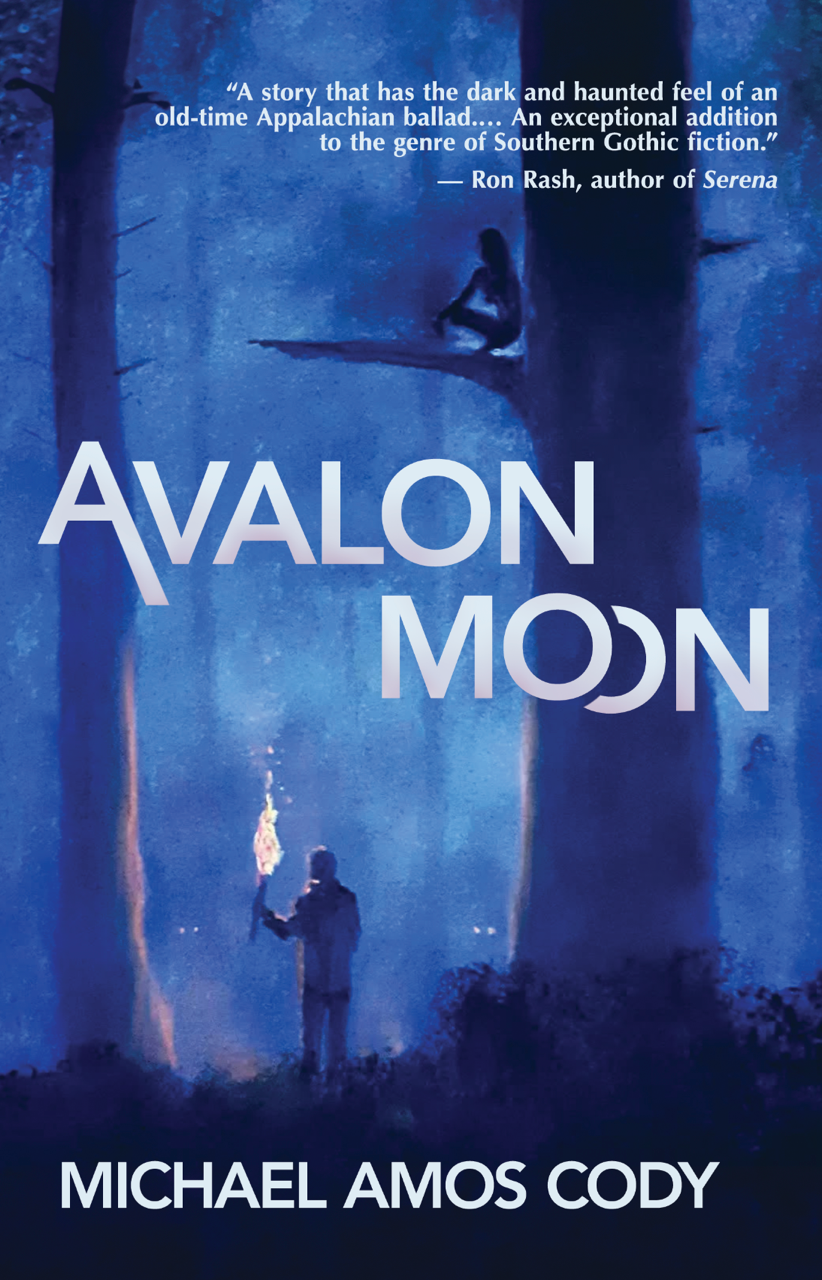
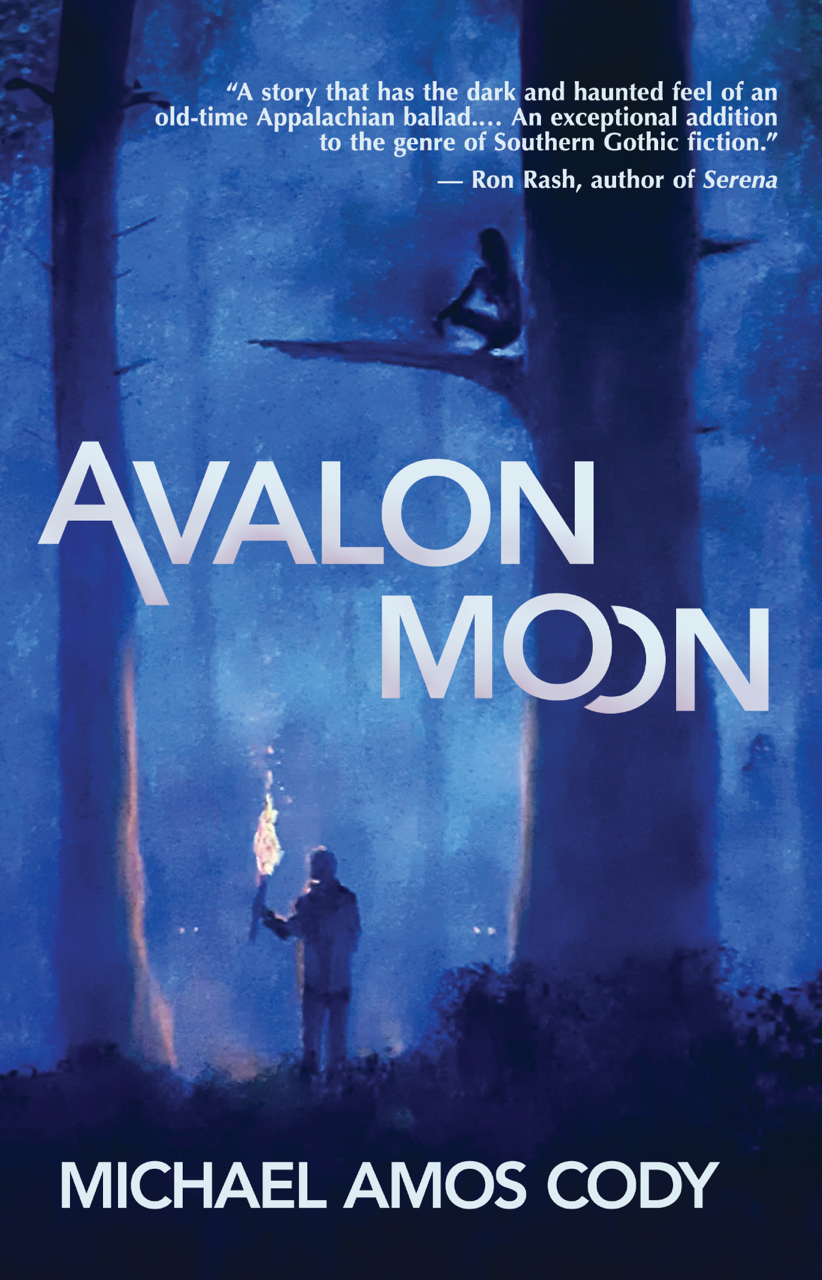
I’m thrilled that the great Appalachian fiction writer and poet Ron Rash—author of Serena and The Caretaker—read Avalon Moon and provided a short review, an excerpt of which is on the image above. Here’s his full “blurb”:
In AVALON MOON, Michael Amos Cody has written a story that has the dark and haunted feel of an old-time Appalachian ballad. Literary echoes of writers such as Samuel Taylor Coleridge and Charles Brockden Brown add to the novel’s richness and make Avalon Moon an exceptional addition to the genre of Southern Gothic fiction.
I’m also thrilled that Mr. Rash will be joining us here at ETSU on Wednesday, April 22, as the featured writer for our Spring Literary Festival. Y’all come!
In the coming weeks, as we approach the May 19 release date, I’ll be sharing more such blurbs from writers I greatly admire.
O God it is so easy to be afraid to be made afraid.
Demagogues of every sort have always counted on our fears to scare us into submission.
Politicians and preachers commissars and evangelists make people afraid— afraid of what will happen to them afraid of death and therefore of life afraid of differences strangers joy.
The fearmongers are so successful because they find in us such willing subjects.
But the gospel of perfect love comes to us to cast out fear— from our beginning.
Some of us have never affirmed our first birth— have never said “Good!” to our emergence “Very good!” to our creation. Be midwife to our self-respect and mother to our growth.
Perfect love will cast out fear and when You are through with us we will be fearless. In the mean time at least help us to move from petty fears to better ones; from fears of hell to admissions of joylessness; from quaking before opinions and modes and fashions to fearing loss of our integrity and untruth in our very souls.
We would say “Bravo!” to our birth our re-birth Your will that created us our choice to be and to become
amen.
Better Than Nice and Other Unconventional Prayers by Frederick Ohler. Louisville, KY: Westminster/John Knox Press, 1989. 28-29.
Early in Streets of Nashville, Ezra MacRae is out walking on Music Row late on a Saturday night. He’s a bit drunk, having been out celebrating his first taste of success as a Nashville songwriter. As he moves along the sidewalk, aware of an approaching storm, he complains to the night that Kate Hathaway didn’t come out to share in the celebration. What Ezra says suggests that, from his point of view at least, they’ve had an interesting and complicated relationship since being introduced by Gabriel Tanner, with whom Ezra also has an interesting and complicated relationship.
Throughout the middle sections of the novel, Kate and Ezra meet a few times in the process, Ezra hopes, of mending their relationship, which broke due to some unnamed indiscretion Ezra committed but can’t remember because he was blackout drunk at the time. But when Burl Davies, his publisher, is murdered, Kate calls to talk, perhaps to console him or perhaps just to gossip, and she ends up coming over with groceries to cook for them—more than once. They eat together and enjoy going to bed together, and they seem to enjoy their conversations both in kitchen and bed.
Readers might notice two things about this time of trying to heal a fractured relationship. First, despite what the meals and the sex might suggest, Kate is certainly not the touchy-feely kind. Even in the midst of their sexual and culinary adventures, she remains on guard and unsure about Ezra, and she doesn’t mind telling him so. On the phone before their first meeting after the shooting at Ave Canora, she tells him, “‘I’m not sure we’re friends anymore’” (71).
The other thing readers might notice about these two is that Ezra doesn’t quite know how to behave around her. She’s doing all this very friendly stuff with him—cooking for him, commanding him into bed (she really does, but he isn’t resistant), keeping him company in a dark time (but not such friendly company as she might’ve been). Still, he’s cautious about what to expect from her visits and what he might say to her during her visits.
As a writer, I like Kate. I like her a lot. But I don’t know what to make of her any more than Ezra does. And I’ve known her longer than he has. She’s part of Gabriel’s story in Gabriel’s Songbook (Pisgah Press, 2017), in which her character is little different—hard edges intact—from how she came to me in Streets of Nashville. She’s redheaded and a chainsmoker. She’s a hard-nosed front-office person, a gatekeeper, in the Music Row offices of Gabriel’s somewhat shady publisher and producer, for whom she’s still working in Ezra’s story.
The last time Kate appears in Streets of Nashville is the Sunday evening Ezra is attacked by Officer Murdoch Perras. Ezra is managing the kitchen while the meal cooks and Kate showers. Perras appears at the back door and forces his way inside. He wrestles Ezra to the living room floor and is choking him with deadly intent, when Kate comes out of the bathroom with her pepper spray and rescues Ezra. Tough as her exterior is, this traumatizes her so that with very little else to say, she leaves Ezra’s apartment and at that point exits the novel. I thought it only made sense that she would disappear, given the trauma and her tenuous, even somewhat antagonistic relationship with Ezra. Add to this the fact that Ezra is falling for Sally Evans. Knowing that Kate will reappear in the third Ezra MacRae novel, currently titled Antaeus, I wasn’t bothered by her exit.
What didn’t occur to me was that readers might develop a different relationship with Kate. The first indication that this might be the case was when a Goodreads reader posted a four-star review, rounded up from “3.75!” The reader reluctantly gave the novel four stars because she seems to have found it a really good read. She took the novel to task for “completely abandoning a character who cared for and seemed to love the main character, who stood up for him in a climactic fight, and is never heard from again.” Almost a dealbreaker for this reader. She writes, “[H]onestly this was so distracting for me i wanted to rate the book 3 stars but i blasted through this book so that didn’t seem fair.” Fair enough, I think. I appreciate fairness, and if I understand her last phrasing, she enjoyed the novel on the whole to the extent that the “blasted through” bit somewhat made up for Kate’s disappearance.
If I have one criticism of the novel it would be that an important character when the novel opens doesn’t figure into the closure the novel offers for other characters, after playing a pivotal role in a particularly traumatic scene. I wanted to know how she dealt with the trauma and her resolution alongside the other characters. (61-62)
Again, fair enough. In my mind, she dealt with the trauma by disappearing from Ezra’s life as she’d disappeared from it at the beginning of the novel due to “some St. Patrick’s Day indiscretion that he couldn’t remember and she couldn’t seem to forget.”
One more. A few days ago, one of my favorite students from the Fall 2025 creative writing class came to interview me for an assignment she had in a Spring 2026 class. After we completed the interview, she told me that she’d read Streets of Nashville once our class together was over. She really liked it, she said. But, like the Goodreads reader and Mr. Clark, she wanted to know what had happened to Kate Hathaway. She was glad to know she wasn’t the only one with that question, and I explained that Kate was so traumatized by the horrific fight in Ezra’s apartment that she removed herself from his life until a later time beyond the end of the novel. My student understood and liked that explanation.
But I was left with the realization that readers can understandably have questions that can be expressed via disappointment. They necessarily don’t have the long-range view of the story and characters that I do, so I should probably keep that in mind going forward. I mean, if I like Kate and have an interest in what happens to her, then I shouldn’t be surprised—in fact, I should be gratified—when readers like her and don’t like to see her leave the story as if forgotten.
Charles Dickens recognized the significant danger ignorance poses to our world in A Christmas Carol (1843). In the last moments that Scrooge spends with the Ghost of Christmas Present, he notices something odd–“‘a foot or a claw'”–protruding from beneath the hem of the spirit’s robe. Scrooge asks about it, and the Ghost reveals what the old man has seen a hint of:
From the foldings of its robe, it brought two children; wretched, abject, frightful, hideous, miserable. They knelt down at its feet, and clung upon the outside of its garment.
When Scrooge asks, “‘Spirit! Are they yours?'” the Ghost replies,
“They are Man’s. . . . And they cling to me, appealing from their fathers. This boy is Ignorance. This girl is Want. Beware of them both, and all of their degree, but most of all beware of this boy, for on his brow I see that written which is Doom, unless the writing be erased. Deny it! . . . Slander those who tell it ye! Admit it for your factious purposes, and make it worse. And bide the end!”
Reviewing images from 6 January 2021’s attempted overthrow of the U.S. government, I see a couple of Black faces–both male. I see many more white female faces. But of course the vast majority of faces are those of white males, most looking very faux MMA or Duck Dynasty: “Big and dull-featured” men.
Altogether, the hot mess of faces that poured through the streets of DC and invaded the Capitol made up a lava flow of IGNORANCE.
I have no doubt that many of those domestic terrorists who attacked the U.S. Capitol on Wednesday, 6 January 2021, are smart in their way, perhaps even articulate in attempting to defend their beliefs and actions (although their actions on that day are, I believe, indefensible even though our Tiamat has pardoned those charged). But I also have no doubt that, to a man, their ignorance, like that of their figurehead leader, is absolute and devouring.
Absent an education about the world, absent knowledge about that world and the self, absent an awareness of the self and the great streams of life within and beyond, the gaping maw of aggressive, malignant ignorance exhibits a taste for little other than animal sensations. Even as animals ourselves, however, humans have incredible capacities for imagination, empathy, sympathy, sensitivity, and love. Ignorance is neither interested in nor capable of these. It is the worst-case scenario of self-centeredness, arrogance, and narcissism.
One dangerous effect of ignorance is instability. The state of being ignorant is one of being ungrounded, unmoored. No matter how substantial the physicality of ignorant men or women or other, the instability resulting from their ignorance leaves them adrift from truth, reality, discernment, and humanity, causing them to be blown around by any wind that reaches them, to be washed this way or that by any tide or flood or pulled under by any insidious riptide.
When 1/6 attackers attempt to defend their actions by saying they just got caught up in the moment, what they’re really telling us that they admit to a destabilizing ignorance that allowed them to be swept away in the chaos manipulated by their supreme leader. For him and them, ignorance has become a state of being, like the air they breathe, and whether this ignorance is individual or corporate, it is unable to know or recognize itself.
Here’s a little story that I lived recently, and it’s something of a cover reveal for Avalon Moon as well.
Back yonder in the days of COVID, I ran across a Facebook group called “Dark Sire,” which was, as I recall (and as I understood it), connected to a publishing venture devoted to the Gothic, as that term is variously defined.
During the period that Dark Sire was active and I was following along, an artist named Shaun Power regularly posted electronic images of his paintings. (You can check out his work on Instagram at @shaunpower90.) I loved pretty much everything he posted and communicated with him a bit via comments on this piece or that. He was always both generous and appreciative in his responses. His work was most often dark (but rarely monstrous or terrifying) and randomly whimsical. No matter what he posted, far more often than not it resonated with me in some way.
One particular painting appeared in a couple of variations and with a few different names. Here’s the version of it that spoke to me the most:
I don’t remember what title this initially appeared under, but I was immediately taken with it – particular shades of blue that are my favorites, the lonely man with the torch (maybe the torch representing desire, as in “carrying the torch” for somebody or something), the eyes of beasts glowing in the darkness, the human beast that haunts the right side of the image, the haunting silhouette of a woman on the broken branch above the lonely man (possibly what he’s looking for with that torch).
At the time I ran across Shaun’s post of this image, I was somewhere early in the process of drafting Avalon Moon. One character physically absent from the story but still a strong presence is named Kayla Logan Reeves. She’s a painter and an elementary school art teacher. Even though she has disappeared by the time the Avalon Moon story begins, I imagined this as the final canvas she worked on. (You can read about Kayla in her younger days in “Jamboree” and/or listen to the same via her song “Jamboree,” which came before the story.)
Anyway, I was so taken with Shaun Power’s painting that I wrote it into my novel as Kayla’s painting (with a couple of story-related adaptations).
Flash forward to fall 2025 when Madville Publishing emailed to ask if I had any ideas for the cover. I sent a handful of images, one of which was Shaun’s. It’s the one I wanted, and it turned out to be the one Madville liked.
We needed Shaun Power’s permission to use his artwork for my novel’s cover, so I immediately set out (virtually) to track him down. After only a few minutes I learned, sadly, that Shaun had walked on from this world in summer 2024. He was basically the same age I am, only a year or so older, so to learn of his death was made more heartbreaking in that he was so young – as I define young from this vantage point of being sixty-seven years old.
After sitting with that loss for a few minutes, I started looking again, hoping to find next of kin who might be interested in granting permission to use the image. I found his wife, now widowed, and his son, both of whom had points of contact but neither of whom seemed to have a very active online life. I wrote a note to each of them, expressing my condolences for their loss and letting them know of my interest in using one of Shaun’s paintings for my book cover. Given their low-level online activity, I didn’t expect to hear back from either.
But I think it was less that thirty minutes before his son got in touch with me and said that he and his mum thought Shaun would love having his work appear on the cover of Avalon Moon, work he was proud to have shared with Dark Sire. Because Shaun published this image under a couple of different titles, his wife and son asked that we credit it as “Shaun’s Strange Land,” which is a variation of one title he gave it.
I can hardly wait to hold the book in my hands and for others to do so as well – those others include the family and friends of the late great Shaun Power.
Sometime in early November 2024, I locked my metaphorical doors and windows, closed the blinds, and more or less abandoned the seriocomic world at large. Bad comedians took the stage (“All the world’s a stage”), their third-rate stand-up routine bumbling through a gag bit “full of sound and fury / Signifying nothing.” Shakespeare aside, I buried my head not in the sand but in teaching and writing and reading.
Teaching: In Spring 2025, I taught a large section of ENGL 2110: American Literature to 1865, my first section of ENGL 3142: Creative Writing I (Fiction), an online section of ENGL 3280: Mythology, and ENGL 5450: Colonial & Federal Literature (a graduate course in early American literature). In Fall 2025, I taught ENGL 3070: Native American Literature (with a focus on Indigenous crime fiction), ENGL 3142: Creative Writing I (Fiction), and an online section of ENGL 3280: Mythology.
Writing: With a little help from my friends, I laid the groundwork for the April 15 release of Streets of Nashville, which was a finalist for Best Thriller of the year according to BestThrillers.com, worked through the final edits of Avalon Moon (to be published by Madville Publishing in May 2026), and drafted the first half of a novel I’m calling Jacob’s Limp, a sequel to Streets of Nashville. I also wrote a short story titled “Brownies at the Chateau LeMoyne.”
Reading: I read a lot via both eyes (mostly hard copy but some electronic texts) and ears (Audible, Libro.fm, Spotify). Here’s a list, structured from January through December 2025:
“The Dead” by James Joyce (technically a short story) Turkeyfoot by Rick Childers Iron Lake by William Kent Krueger Exposure by Ramona Emerson Let Us Descend by Jesmyn Ward Those We Thought We Knew by David Joy Down the River Unto the Sea by Walter Mosley The Westside Park Murders by Keith Roysdon & Douglas Walker Notes on a Drowning by Anna Sharpe The Caretaker by Ron Rash Cahokia Jazz by Francis Spufford Genesis Road by Susan O’Dell Underwood The Wailing Wind by Tony Hillerman Hunting Badger by Tony Hillerman Nowhere by Allison Gunn The Coquette by Hannah Webster Foster Smoke Kings by Jahmal Mayfield The Busker Wars by Whiskey Leavins The Sinister Pig by Tony Hillerman Wieland by Charles Brockden Brown King Cal by Peter McDade The Daughter of Time by Josephine Tey The Reluctant Sheriff by Chris Offutt All the Pretty Girls by J.T. Ellison Dixie City Jam by James Lee Burke People of Darkness by Tony Hillerman The Last Songbird by Daniel Weizmann Served Cold by James L’Etoile Unsettling Truths by Mark Charles and Soong-Chan Rah Skeleton Man by Tony Hillerman A Séance for Wicked King Death by Coy Hall Last Chance for a Slow Dance by Mark D. Baumgartner That October by Keith Roysdon We Are All Together by Richard Fulco The Last King of California by Jordan Harper Traveling Alone by Katy Goforth The Buffalo Hunter Hunter by Stephen Graham Jones King of Ashes by S.A. Cosby Rednecks by Taylor Brown This House of Sky by Ivan Doig Rain Gods by James Lee Burke Master and Commander by Patrick O’Brian Songs by Honeybird by Peter McDade House Made of Dawn by N. Scott Momaday That Which Binds Us by Cathy Rigg Tonight in Jungleland by Peter Ames Carlin Winter Counts by David Heska Wanbli Weiden Avalon Moon by Michael Amos Cody Shutter by Ramona Emerson Boundary Waters by William Kent Krueger Mean Spirit by Linda Hogan Dead Man Blues by S.D. House The Witch’s Orchard by Archer Sullivan The Round House by Louise Erdrich The Devil’s Bed by William Kent Krueger Gray Dawn by Walter Mosley Bone Game by Louis Owens The House on Buzzard’s Bay by Dwyer Murphy A Rising Man by Abir Mukherjee Murder on the Red River by Marcie R. Rendon The Serpent King by Jeff Zentner Avalon Moon by Michael Amos Cody There There by Tommy Orange Killer Clown by Terry Sullivan with Peter T Maiken Nightshade by Michael Connelly Avalon Moon by Michael Amos Cody A Christmas Carol by Charles Dickens The Familiar Stranger by Tyler Staton
I’ve done more teaching, writing, and reading along the way–some concluded in 2025, some continuing into 2026. I’ll leave it at that for now and wish everybody, especially anybody who reaches the bottom of this post, a happy, healthy, and safe New Year.
P.S. Yes, I know that I read Avalon Moon three times, but . . . I read it three times!
The front picture is of me as I looked when I wrote “Christmastime.” The performance is by me now, thirty-four years later.
As I recall . . .
It was in the spring of 1988, and I was writing songs for Ave Canora, a small publishing venture that was part of the music empire of Nashville/Broadway singing star Gary Morris. Word ran through the offices of Gary Morris Music that he would be recording a Christmas album in the near future. I’d never written a Christmas song before, but I really wanted to have a song on that album.
So, in April 1988, in the midst of that year’s Easter season, I sat down to write “Christmastime.” My main musical influences were only two: almost 30 years of hymns and carols in my little mountain church and community in Walnut, North Carolina, and Johnny Mathis’s album Merry Christmas, the Christmas album of all Christmas albums as far as I’m concerned, released in October 1958, less than two months before I was born. I was writing a lot of songs in the key of E at the time, and so, E it was for “Christmastime.”
Here’s an early recording of “Christmastime” from the home studio of my friend Mark Chesshir. It’s possible that this is the demo that I turned in to Ave Canora and the version that Gary heard.
Verse #1 is all about light, which is one of my true loves in the Christmas season. Leesa and I don’t decorate the exterior of our house, but I love the lights of Christmas. Light designs and displays–from simple to complex–are the only thing I enjoy about the extended Christmas season the Xian world developed due to the demands of capitalism.
See the world In a different light At Christmastime. See it shine In the children’s eyes At Christmastime. Let the season sparkle in me Like the moon on virgin snow Fallen some long-ago Christmastime.
We have light appearing in “shine” and “sparkle,” and we have “light” in its different connotation of understanding–to see the world in a different light. Many of us give the world a little more grace at Christmastime. Or maybe we express a little bit of righteous anger at the commercialism that isn’t as much in our faces as at other times of the year. With “virgin,” the lyric includes just a taste, an essence, a foreshadowing, of the Christian story of the birth of Jesus. And the “snow” is classic in terms of memory and desire, for me, as I’m always “dreaming of a white Christmas.”
Verse #2 is about memory. The older I get, the more precious and haunting memory becomes, perhaps especially in the context of Christmas. So much of the celebration and so many of the people I’ve celebrated with are yearly lost and fade into memory.
Window pane– Watching a parade Through frosty lines. Memories– Bittersweet and homemade– Cross my mind. Family and friends at the door– With the laughter and the kisses pour Love and good wishes for Christmastime.
This verse is made up of images from memory. These memories, however, are only implied. They’re left vague and general so that the listener (reader) can plug in their specific memories and memory images. I doubt if I thought that at the time I was writing this lyric, but it’s the way I understand it now.
Verse #3 returns to the Christmas story a bit more directly than the intimation of “virgin” in the first verse. We have a star and a child, a call for peace and stillness, a sounds of celebrating bells and singing people and angels.
Distant star, I am not alone With you in sight. In my heart, There’s a little child Alive tonight. So, let the world lie peaceful and still While the bells ring and people sing And angel wings are whispering, “It’s Christmastime.”
I hope that I got chills, that I maybe even cried, when I completed this last verse. It’s all there, I think, all that Christmas has been to me–all that I struggle to have it still be to me. The star that guided the wise men guides me to the child that is still alive in me. The moon on virgin snow exists as part of a world lying peaceful and still. The parade, the laughter, kisses, and good wishes are echoed in the ringing bells and the singing people. And at the end, the lyric returns one last time to the original Christmas story of angels–the “heavenly host”–appearing to the shepherds.
See the world In a different light At Christmastime. See it shine In the children’s eyes At Christmastime. Let the season sparkle in me Like the moon on virgin snow Fallen some long-ago Christmastime.
Window pane– Watching a parade Through frosty lines. Memories– Bittersweet and homemade– Cross my mind. Family and friends at the door– With the laughter and the kisses pour Love and good wishes for Christmastime.
Distant star, I am not alone With you in sight. In my heart, There’s a little child Alive tonight. So, let the world lie peaceful and still While the bells ring and people sing And angel wings are whispering, “It’s Christmastime.”
Many thanks to everybody who, over the years, has said that it’s not really Christmas until they’ve heard “Christmastime”!
“Merry Christmas to all!”
Here’s some more stuff:
I’ll go ahead and say it (with some regret and bitterness, and with apologies for the latter): I have a crass commercial desire that many singers had recorded “Christmastime” so that I could have a nice little royalty bonus every year . . . and so could Leesa when I’m gone . . . and so could Lane and Raleigh when Leesa’s gone. . . .
When I first moved to Johnson City, people used to say, “Hey, I heard ‘Christmas Time’ in K-Mart today!” I even heard it there a time or two myself. But, you know, K-Mart’s not around anymore. (There’s the bitterness again, and again, I apologize.)
Jimmy Patterson was a fellow I met years ago when Leesa, Raleigh, and I attended Cherokee United Methodist Church. He loved “Christmastime.” I heard it told that the first time I played it at Cherokee, Jimmy was standing with our pastor David Woody, and in his excitement over what he was hearing, Jimmy took Pastor Woody’s hand and squeezed it. I don’t know if that’s true, but I do know that “Christmastime” meant so much to Jimmy that his wife Bonnie asked me to play it at his funeral / celebration of life . . . in the summertime, as I recall.
One last thing: Gary Morris released two different versions of his album Every Christmas.
I don’t remember exactly why this was the case, but here’s my story about it. He already had the original Every Christmas album recorded and turned in to Warner Brothers Records by the time I submitted “Christmastime.” That’s the cover on the left, released in 1988. The last song–track 10 on that one–was Gary’s version of “Carol of the Bells.” Then at some point soon afterwards, no later than Christmas 1990, they repackaged and rereleased the album–new cover (on the right) and “Christmastime” replaced “Carol of the Bells.” In practical terms, just as far as publishing goes, Gary’s company would receive what was called mechanical royalties for “Christmastime” that he wouldn’t receive for “Carol of the Bells.” I doubt that was the driving force behind the change, but it was a side effect. Now, on Gary’s website, the album on the left is for sale instead of the later “blue” version. Interestingly, the side effect here is that whoever gets the money for sales of that “poinsettia” version does not have to pay mechanical royalties to me because “Christmastime” isn’t on that version. Given this, I think it’s worth noticing that Spotify, iTunes, and other platforms sell only the “poinsettia” version, so . . . no Christmas royalties for me!
O the bells ring and people sing and angel wings are whispering, “It’s Christmastime”!