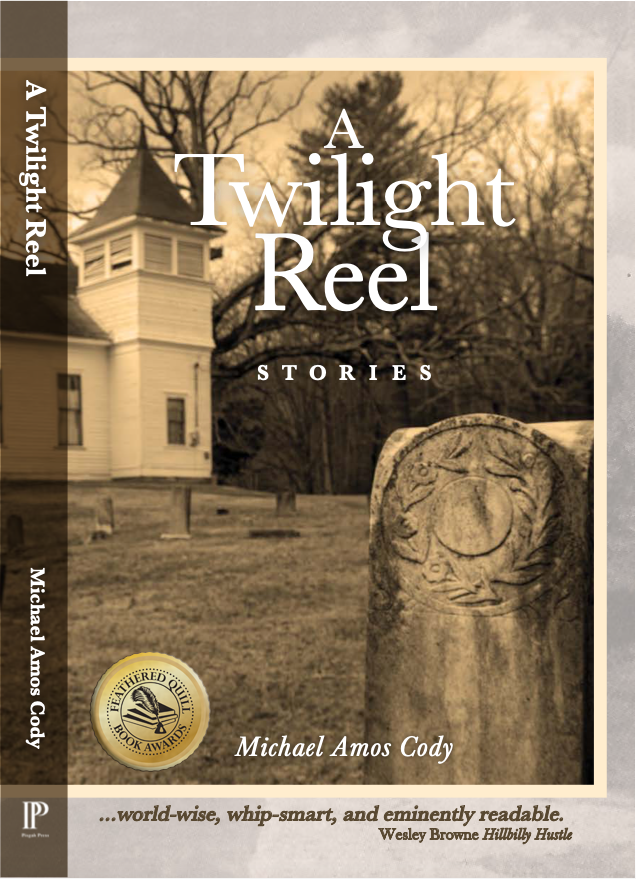
I’m looking forward to Streets of Nashville. I’m confident I’ll spend some time on a top-drawer Whiskey review for that one if it’s even in the ballpark of your previous work. I still recommend A Twilight Reel every chance I get.
Published May 27, 2021
This book of stories was more than twenty-five years in the making. I began it while working on my Master of Arts in English at Western Carolina University under the direction of Rick Boyer (before Ron Rash landed at WCU). Three stories–“The Wine of Astonishment,” “Overwinter,” and “A Poster of Marilyn Monroe”–appeared in my WCU master’s thesis in 1995. The work continued until I finished the final story–“Witness Tree”–in May 2019.
Many of the stories were published as stand-alones through the intervening years:
“Overwinter” (Yemassee 1997)
“The Wine of Astonishment” (Short Story 2000)
“A Poster of Marilyn Monroe” (Pisgah Review 2005)
“The Flutist” (Yemassee 2014)
“The Invisible World around Them” (The Chaffin Journal 2014)
“Two Floors above the Dead” (Tampa Review 2017)
“Conversion” (Still: The Journal 2021)
Thanks to Andy Reed, Pisgah Press, and all who have supported A Twilight Reel over it’s 1,039 days in the world through review, purchase, reading, and on and on. It means a lot.
My blogging schedule calls for some monthly writing on writing every first Wednesday. I missed it by a couple of days. . . .
So, here’s some brief news about what’s going on in my writing life.
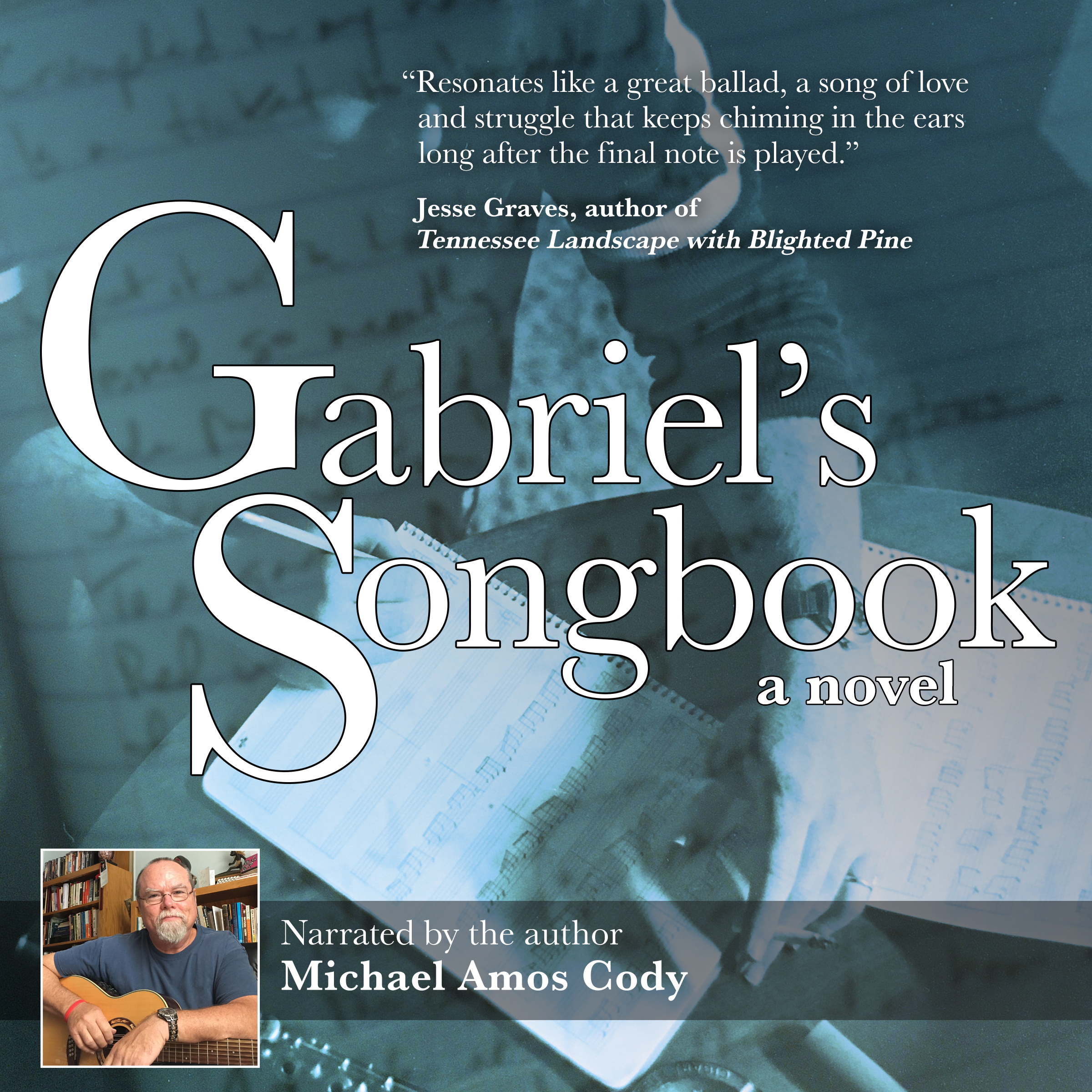
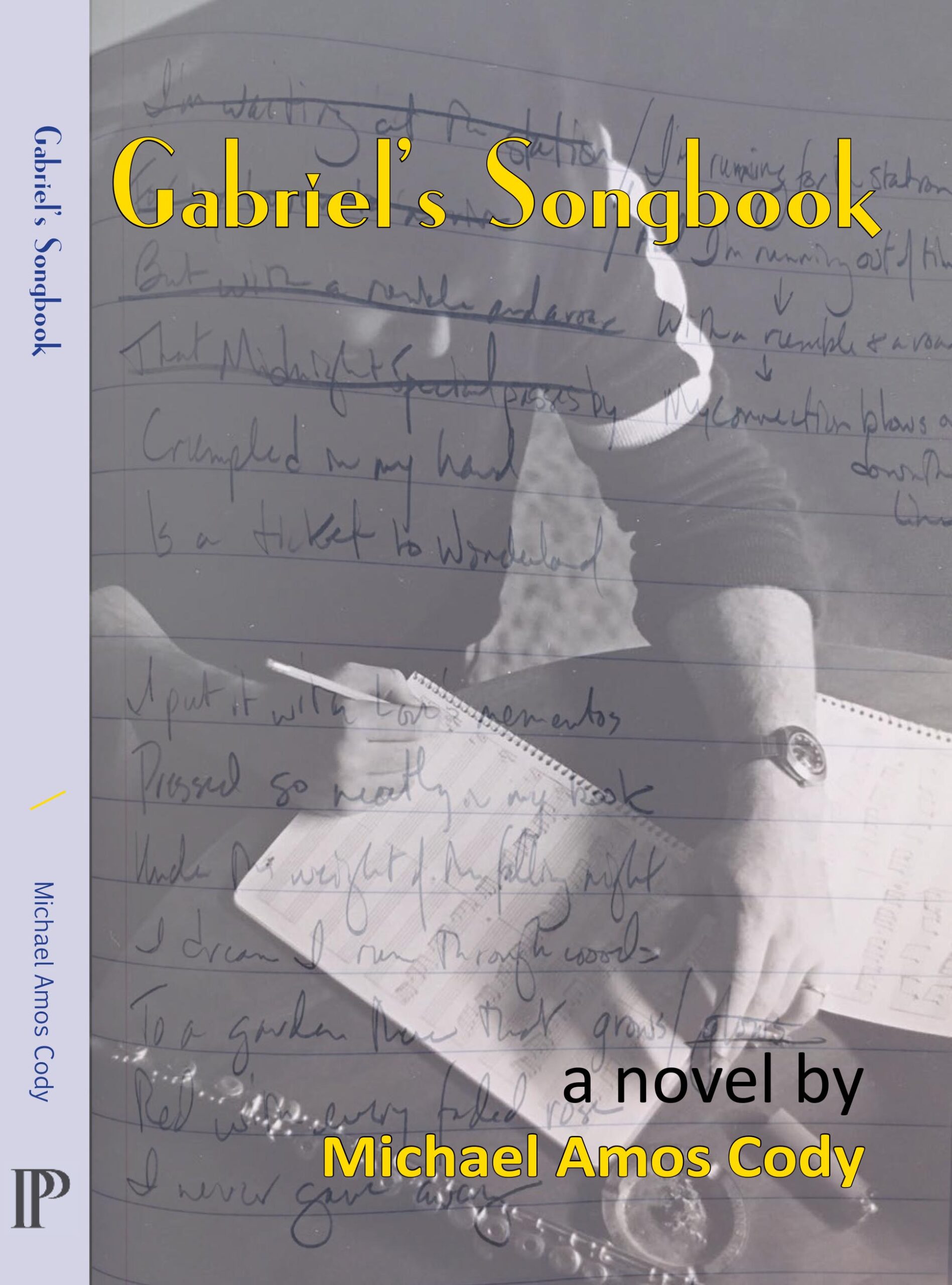
Gabriel’s Songbook audiobook “cover”—photo by Ed Huskey; original design by Andy Reed and Michael Cody; audiobook adaptation by Jamie Reeves
When the Spring 2024 semester ended, I spent a couple of weeks in May driving over the mountain to Asheville, where I wound up at The Talking Book studio to record my own narration of Gabriel’s Songbook. Dave Burr was the engineer, and I had a great time working with and getting to know him. The audiobook is now out in the world. It’s available on a number of platforms—Libro.fm, Spotify, and others. It should appear soon on Audible.
I’m no actor. I’m no voice actor either. But I don’t cringe when listening to the finished version, which makes me think that it’s all right. Give it a listen!
Bouchercon 2024! According to the website, “Bouchercon® is the annual world mystery convention where every year readers, writers, publishers, editors, agents, booksellers and other lovers of crime fiction gather for a 4-day weekend of education, entertainment, and fun!” This is my first time to attend this convention, which meets at the end of this month (August 28 – September 1) in Nashville.
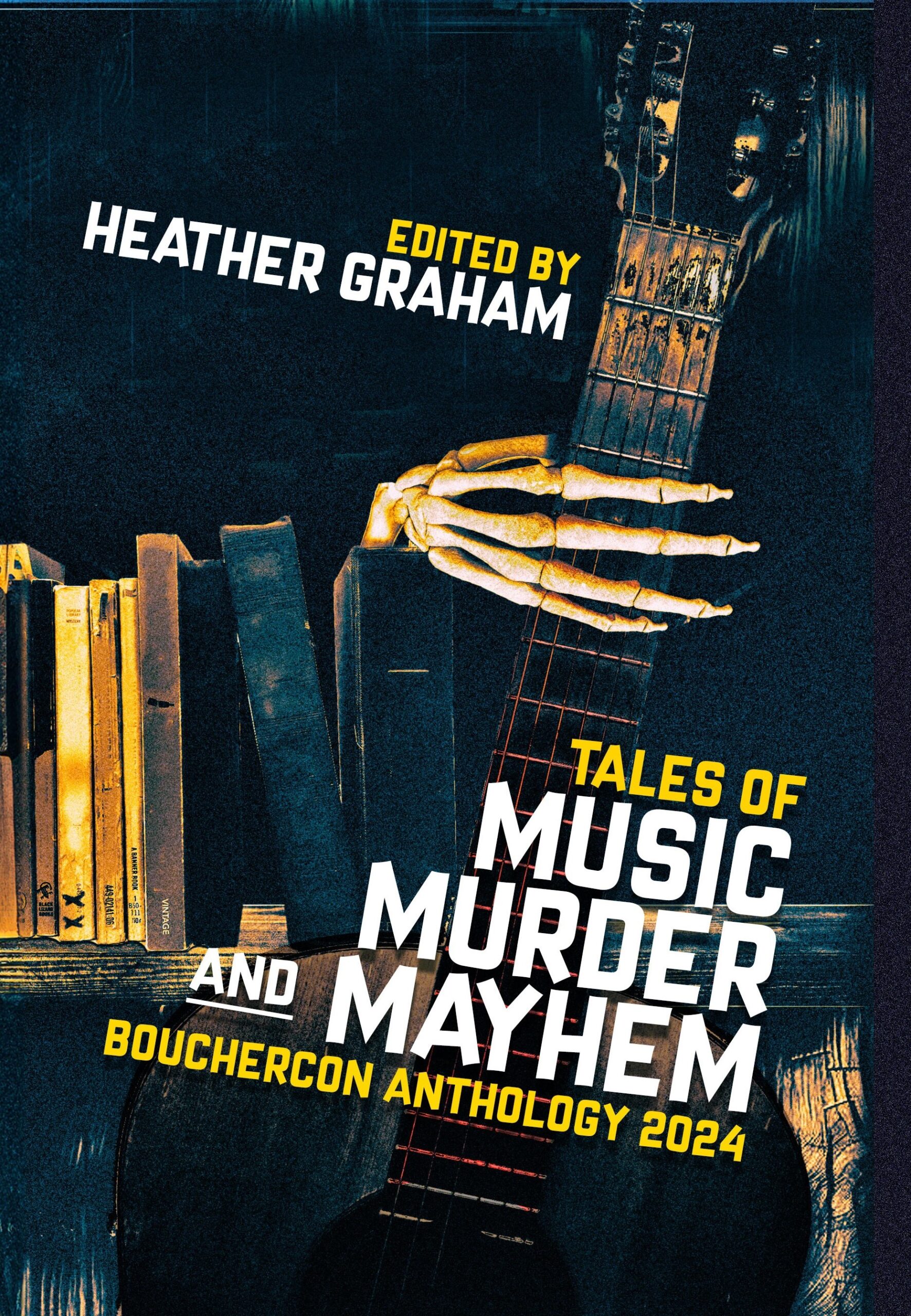
Cover of the Bouchercon Anthology 2024
Every year Bouchercon puts out a call for traditional crime short stories related to the conference’s host city. Having lived in Nashville through my twenties, I thought I’d give it a shot. I’d recently been working on a novel called Streets of Nashville (see below), which features a main character named Ezra MacRae. In the novel, Ezra is about five years into his attempt to establish a viable career as a songwriter, so I thought I would write a short story that explores Ezra’s backstory a little. My submission to the Bouchercon anthology was “I Could Be the One.” It tells of Ezra’s first days/months/year in Nashville as he tries to find his footing on Music Row. I looked through my song catalog and landed on an old piece of mine—”I Could Be the One,” of course. (Read more about the song here.)
The story was accepted and will be included in the Bouchercon anthology for the Nashville conference! I look at this as a fine feather in my cap. The anthology will debut at the conference and afterwards be available wherever books are sold. I still love Nashville, even more than thirty years gone from it, so I’m looking forward to reading the other stories in the anthology as well.
I wrote “I Could Be the One” in October 2023. As soon as I finished it, I jumped on another anthology opportunity.
I spent November 2023 writing “Carolina,” based on Texas songwriter Robert Earl Keen’s song of the same name. It’s a bit of a murder ballad and includes suggestions of a man perhaps murdering his lover while sleepwalking. Whether he’s sleepwalking or not, he finds her (after she’s left him) and then wakes up later to find her dead.
This scenario immediately made me think of my work with the writings of Charles Brockden Brown, who wrote a couple of pieces in the late 18th / early 19th centuries about sleepwalking and murder. The first is his novel Edgar Huntly; or, Memoirs of a Sleep-Walker (1799). In 1805, Brown published a piece of short fiction titled “Somnambulism. A Fragment.” In this story, a young man named Althorpe fearfully obsesses over the safety of his beloved on a nighttime trip she is beginning with her father. Althorpe walks in his sleep and finds her in the night and murders her, bringing his obsessive fears to life—without knowing it.
In the song, the ill-fated girl is named Lily. I kept the name for my story and made her the centerpiece of a conflict between two men: the violent Al Thorpe and Asheville PD detective Eddie Huntly. This story was so much fun to write!
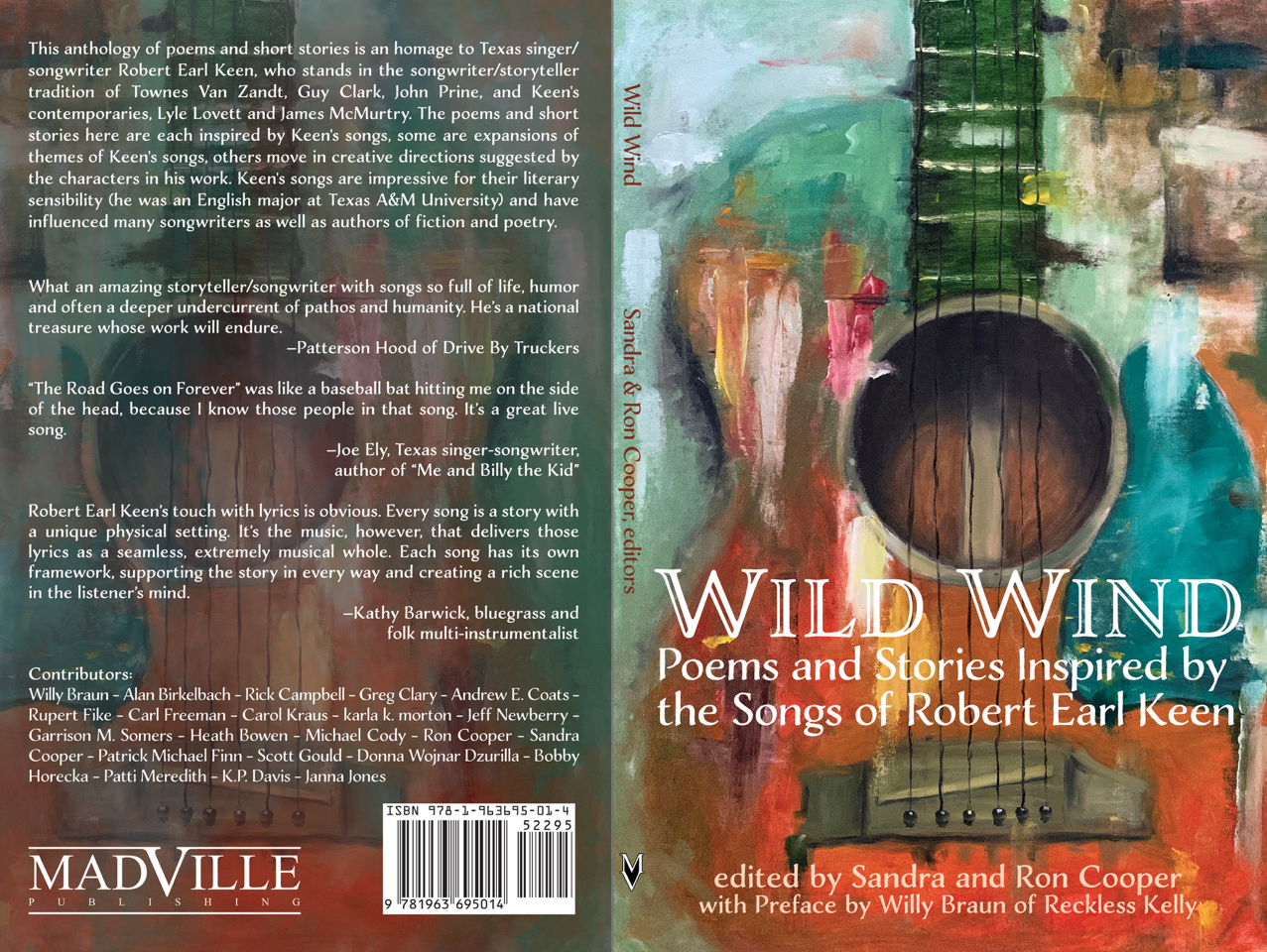
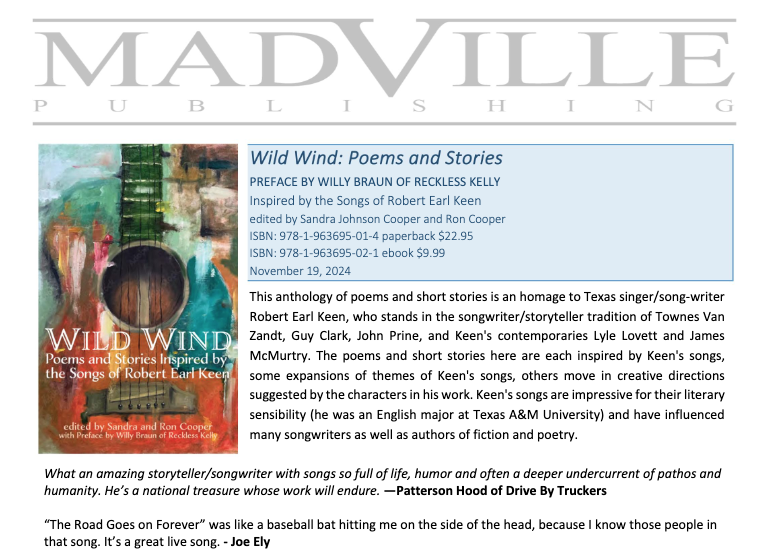
“Carolina” will appear in Madville Publishing‘s Wild Wind: Poems and Stories Inspired by the Songs of Robert Earl Keen. The book is scheduled for release on November 19 and will be available wherever books are sold.
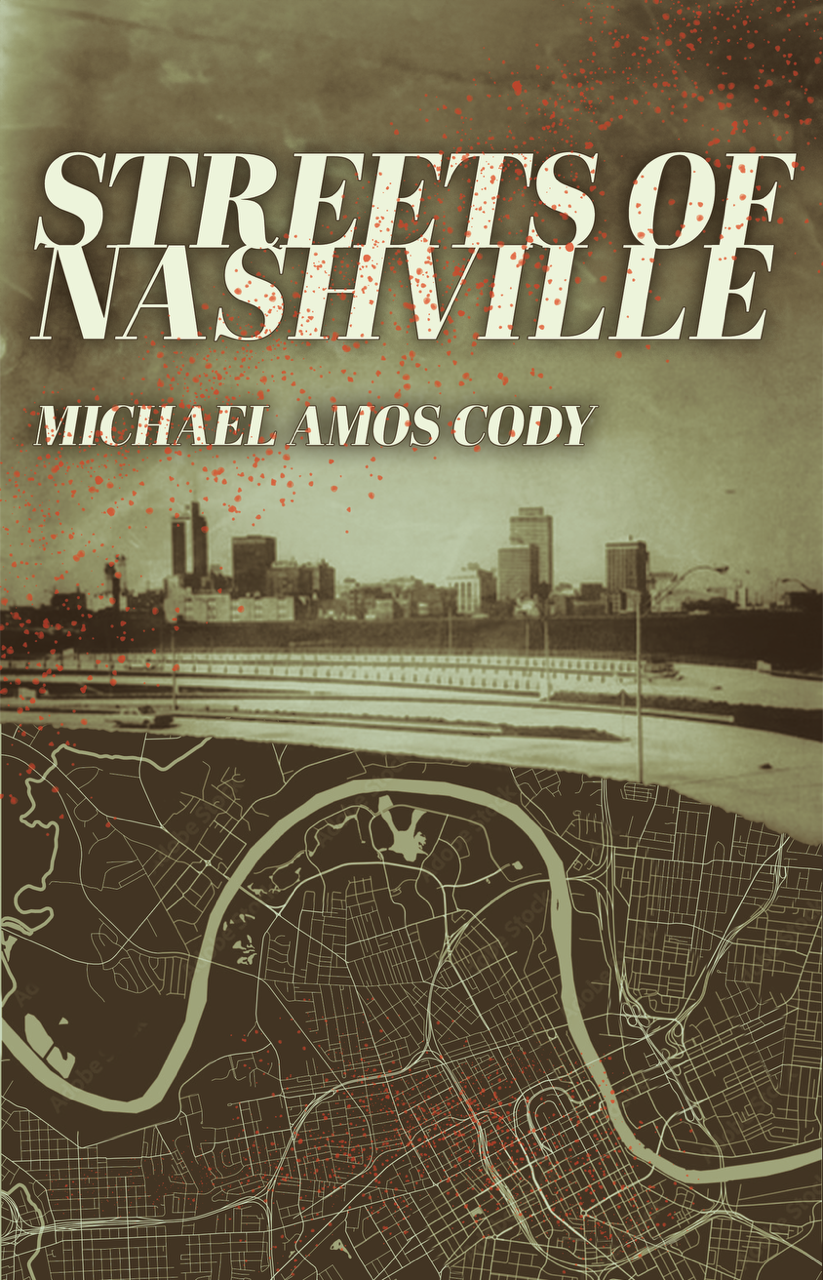
Streets of Nashville is my second novel (third book of fiction). On April 15, 2025, Madville Publishing will release the novel into the wild world (whatever form that takes after the November election)! From the above, you can gather that its main character is a songwriter named Ezra MacRae, five years into his attempt to establish a viable career on Nashville’s Music Row. I won’t say much more about it right now. Madville’s editor and I are working with the final proofs of the text, so I should soon have an advance reading opportunity available for pre-release reviews. In the meantime, you can read the query letter that I sent to Madville, which led to acceptance and the start of the publishing process. (Thanks to the great Alex Kenna for providing this query letter space!)
This is a secret cover reveal! I’ll do a more public one on my socials as soon as the text of the book is finalized. For now, we’ll see if anybody actually reads this blog. And if anybody does, they’re the first to lay eyes on this cover.
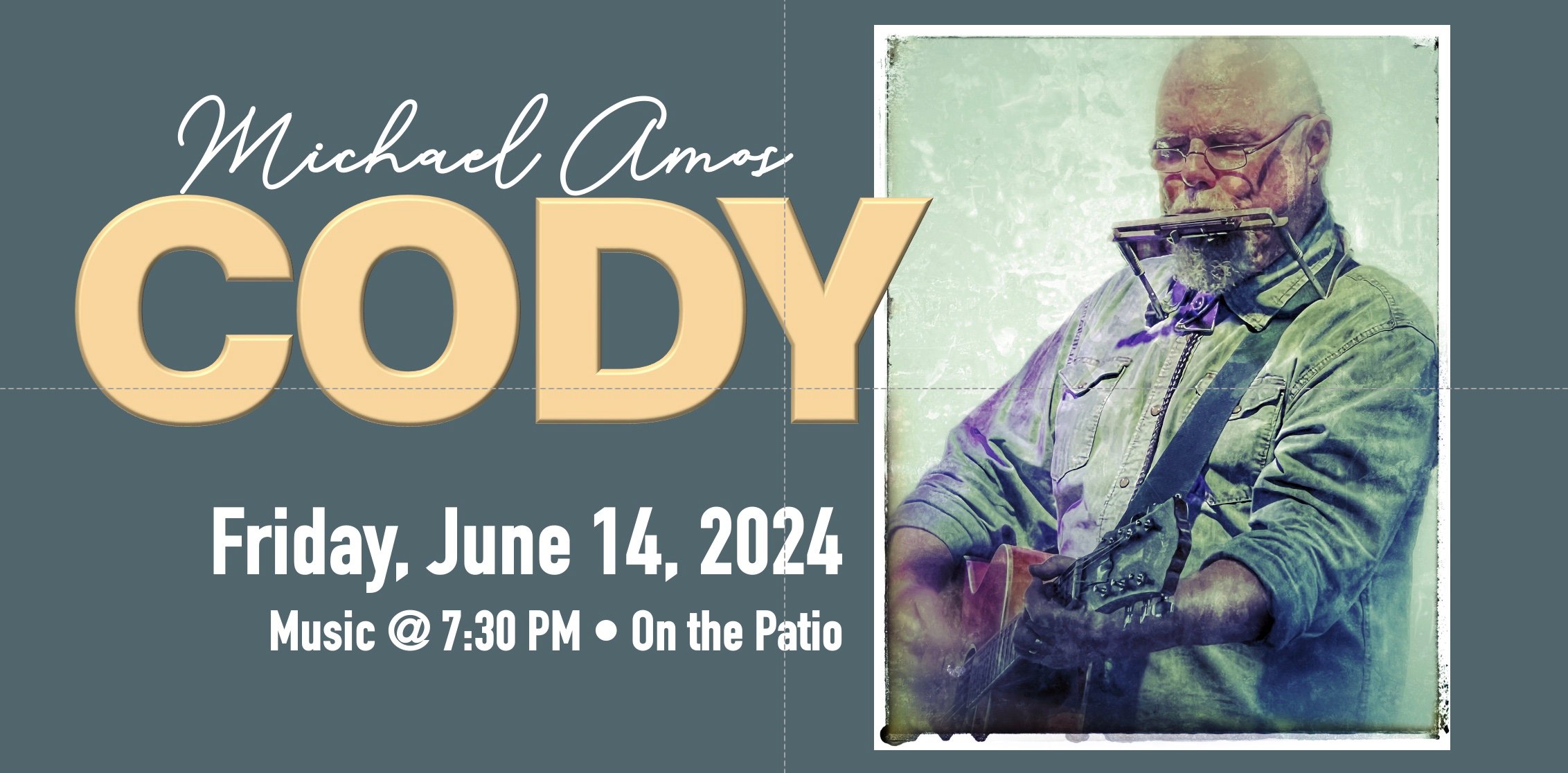
“This Is Not All” is a new song that has been with me for a while. In fact, I’ve had much of it written for several years, so I suppose it’s more accurate to say that it’s a newly completed song. It’s so newly completed that I haven’t even learned it yet. Still, that didn’t stop me from trying to play it at a recent gig on the Barnett Patio. I flubbed a bunch of it, especially toward the end, but it’s now out there in the world. I’ll continue to work on the music, but I feel like the lyrics are finished and say what I want them to say.
The first verse began with hiking a trail—going on a ramble, as my friend Scott Honeycutt calls it. The lines borrow some sentiments from Emerson, Thoreau, and Dickinson (and many others, I’m sure). We too often go out into nature, as Emerson and Thoreau caution us, looking for the big payoff in the scenery—a dramatic waterfall, the colors of autumn leaves, the mountaintop view of distance (even to the moon). Emerson writes in “Beauty,” the third chapter of Nature, “Go out of the house to see the moon, and ’tis mere tinsel; it will not please as when its light shines upon your necessary journey.”
But the trail offers much at which to wonder that is seen only if we turn our eyes away from the big picture, away from the big expectations, and look down—not necessarily down, but just look.
Not all the wonder along the trail is to be found in woods and sky— look closer. It’s the tiny frog hidden in clover and that creature in the dust with a hundred legs or more. It’s in how I find my way home and that flower I never noticed by the door.
I like the last two lines in particular. Have you ever thought about how wonderful it is that you can—as long as you have a sound mind—find your way home? And you probably know many different ways to get home. Consider the Keb’ Mo’ song “More Thank One Way Home.” Take that as realistically or metaphorically as you wish.
As for the last line, Emily Dickinson writes in her poem 446 (Franklin; “This was a Poet”) that the poet
Distills amazing sense From Ordinary Meanings – And Attar* so immense
From the familiar species That perished by the Door – We wonder it was not Ourselves Arrested it – before –
(*Attar = fragrance)
Here, Dickison suggests—as Emerson does in his essay “The Poet”—that the poet (or the poetic eye) sees the richness, even the strangeness and wonder, in the familiar. Although those without the poet’s vision are subject to a kind of “ceaseless Poverty,” we still have the potential to understand and be enriched through that vision. That is, once the poet points out the wonder in the “familiar species / That perished by the Door”—”that flower I never noticed by the door”—we are enriched second-hand.
The second verse of “This Is Not All” sticks with wonder and the wonderful:
Not all the wonder along the way is waiting somewhere far ahead— look closer. A little boy runs in cape and mask, another stands shirtless in a barnyard banging a drum. A little girl learns to cartwheel, And another stands by the road and sticks out her thumb.
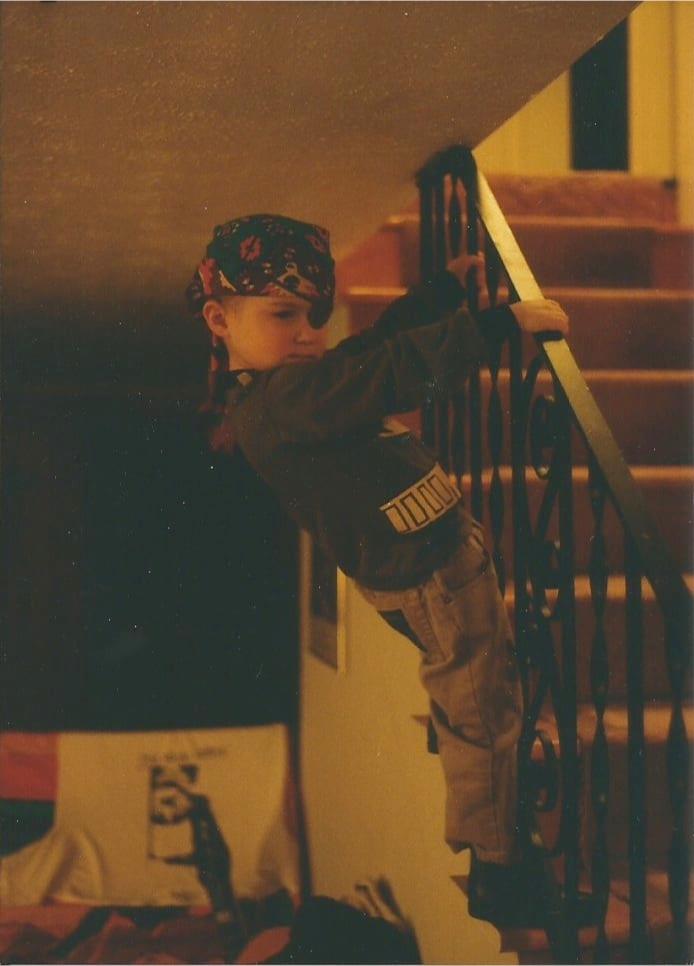
The idea here is that when we travel, whether on the road or trail or metaphorically through life, we often let the destination or goal loom so large in our minds that we ignore or lose sight of what is wonderful “along the way.” Consider the old adage that the journey is more important than the destination. The “little boy” is my son Raleigh, who had a vivid imagination and a love of costume.
The image of the other boy is from my travels at some point some years ago. I was driving in Indiana or Illinois or Iowa—somewhere with corn to the horizon. Just off the interstate was a large farmhouse, a big barn to the right of it (in the background, corn to the horizon from which a storm approached). In the barnyard, this kid—a teenager, at least—sat behind a full drum set and seemed in the middle of a massive rock ‘n’ roll show drum solo. A vivid, amazing scene!
The cartwheeling and hitchhiking girls are less real images than they are contrasts in innocence and experience, security and danger. But each of these has in it an element of wonder.
The song takes a dark turn to look at evil. The third verse recognizes that we leave ourselves open to the threatening workings of evil if we believe that it exists only in obvious places—”the terrorist and thief.”
Not all the evil in the world is in the terrorist and thief— look closer. It’s in the thousand faces of ignorance— political and corporate and religious. It’s in the hate and hunger and the trumped-up fights that pit them against us.
Ignorance is possibly the worst evil in our world today. Many of us seem to be getting to the point where we can’t see anything except through the lenses of ignorance, rage, and prejudice, our desire to win at all cost (while too ignorant to count the ultimate cost), our desire to “own” ______ [insert your fear/hate here], the devotion of our time and minds and hearts to conspiracy (which even if real probably has little to do with you and your little you might brighten). Charles Dickens wrote in his last scene with the Ghost of Christmas Present about “a boy and girl” that Scrooge spots hiding under the skirts of the Ghost’s robe, children [y]ellow, meagre, ragged, scowling, wolfish. . . .” When Scrooge asks if they are the children of the Ghost of Christmas Present, the spirit answers,
“‘They are Man’s. . . . And they cling to me, appealing from their fathers. This boy is Ignorance. This girl is Want. Beware of them both, and all of their degree, but most of all beware this boy, for on his brow I see that written which is Doom, unless the writing be erased. Deny it! . . . Slander those who tell it ye! Admit it for your factious purposes, and make it worse! And bide the end!'”
Charles Dickens’s A Christmas Carol
In our devaluing of education and of ourselves along with it, we have opened the door wide to all sorts of evil. The ignorant parents and grandparents and legislators slander teachers as misleading and “indoctrinating” their students. The ignorant revel in their ignorance as their badge of difference from the educated and the expert. (This is what Dickens refers to when he writes, “Admit it for your factious [that is, divisive] purposes, and make it worse!”). Thomas Jefferson—author of the U.S. Declaration of Independence—wrote elsewhere that “the spirit of the people [is not] infallible” and we “will become . . careless. A single zealot may commence persecutor, and better men be his victims.” I think the “single zealot” is now among us in Donald Trump, who is Dickens’s boy Ignorance personified. Beware! “Deny it” and experience the “Doom” he brings.
And yet perhaps there is still goodness. Fear and hate cannot survive honest expressions of love between people, between peoples, between us. Someone who becomes friends with—who comes to love—that which is feared, be it a skin color or a faith system or an identity (LGBTQ+) or whatever, usually finds it difficult, if not impossible, to fear and hate the person that has now become, to them, a human being—recognizing another as a human being, as a child of God (if you will). And that’s what it’s about, I think, opening up of ourselves to see the humanity in everybody. It is in this recognition and love that fear and hate begin to wither and die for lack of nourishment.
That said, I suspect we’re too far gone into ignorance—and an arrogance that prevents us from recognizing our ignorance—to survive.
Still, for the song, I lifted up my mind and heart and wrote a bridge and a fourth verse and tied it all together with a refrain “This Is Not All,” which first appears after the second verse and then repeats after the third and at the end.
The means of control are more than out of our hands— they’re far beyond our reach. But we can love, and love’s the root and height of all and love’s the root and height of each.
Not all the goodness in the world is to be found in church and child— look closer. It’s in the unshackled hearts that lift us high above the right or wrong or Right or Left— my friend’s warm hand in mine and true emotions honestly expressed.
This is not all, no, this is not all! Out there is more than we can own, more than we can protect. This is not all, no, this is not all! Out there is more than can be known, so much more than we expect. This is not all!
This Is Not All
Not all the wonder along the trail is to be found in woods and sky— look closer. It’s the tiny frog hidden in clover and that creature in the dust with a hundred legs or more. It’s in how I find my way home and that flower I never noticed by the door.
Not all the wonder along the way is waiting somewhere far ahead— look closer. A little boy runs in cape and mask, another stands shirtless in a barnyard banging a drum. A little girl learns to cartwheel, And another stands by the road and sticks out her thumb.
This is not all, no, this is not all! Out there is more than we can own, more than we can protect. This is not all, no, this is not all! Out there is more than can be known, so much more than we expect. This is not all!
Not all the evil in the world is in the terrorist and thief— look closer. It’s in the thousand faces of ignorance— political and corporate and religious. It’s in the hate and hunger and the trumped-up fights that put them against us.
This is not all, no, this is not all! Out there is more than we can own, more than we can protect. This is not all, no, this is not all! Out there is more than can be known, so much more than we expect. This is not all!
The means of control are more than out of our hands— they’re far beyond our reach. But we can love, and love’s the root and height of all and love’s the root and height of each.
Not all the goodness in the world is to be found in church and child— look closer. It’s in the unshackled hearts that lift us high above the right or wrong or Right or Left— my friend’s warm hand in mine and true emotions honestly expressed.
This is not all, no, this is not all! Out there is more than we can own, more than we can protect. This is not all, no, this is not all! Out there is more than can be known, so much more than we expect. This is not all!
[Due to excessive commenting from Russian bots, I have stopped allowing comments on this blog. If you are not a Russian bot (or a bot of any other persuasion) and would like to comment, please email me at michaelamoscody@gmail.com.]
I’m late to this anthology party, but I’m glad to be here finally and having fun.
What party? Again, I’m late to this, but it seems that a whole new world of opportunities has opened for creative writers of fiction (flash fiction and short stories), poems, and creative nonfiction (again, flash and short). The literary and not-so-literary magazines were once about the only places I could go to try and publish my short stories individually, but now I’ve sat up and taken notice of several anthologies looking for material that I might’ve already written or might yet write.
I’ve had a couple of gratifying successes so far. . . .
Every year, Bouchercon (aka the World Mystery Convention) publishes an anthology of traditional crime stories set in or related to the city hosting that year’s meeting. This year, Bouchercon 2024 meets in Nashville, TN. So, I took an old song of mine — “I Could Be the One” — and used it as a prop in a story about theft of intellectual property on Music Row. The story was accepted! The anthology titled Tales of Music, Murder and Mayhem: Bouchercon Anthology 2024 will be released by late August. Here’s a link to the now closed call for submissions I responded to. Every year, the Bouchercon anthology benefits a charity local to the host city, and this year, sales of the anthology will benefit Dolly Parton’s Imagination Library. And get this — Dolly is writing the introduction! More on this anthology as the publication date comes nearer.
One thing I think is cool about “I Could Be the One” is that it turned out to be a prequel to my novel Streets of Nashville, forthcoming from Madville Publishing in April 2025. More on that soon as well.
My next anthology success will appear in Madville‘s Wild Wind: Poems and Stories Inspired by the Songs of Robert Earl Keen, coming in November 2024. Here’s just a bit about what’s in it: “The poems and short stories here are each inspired by Keen’s songs, some expansions of themes of Keen’s songs, others move in creative directions suggested by the characters in his work.” I found a Keen song called “Carolina” and built from its lyrics a story of the same name. Keen’s lyrical story is set in Asheville, NC, and includes hints of sleepwalking and murder. I had some fun adapting some of my scholarly interest in Charles Brockden Brown — his use of somnambulism and a couple of his character names — into a piece of crime noir.
(Not sure if that’s the official cover pictured)
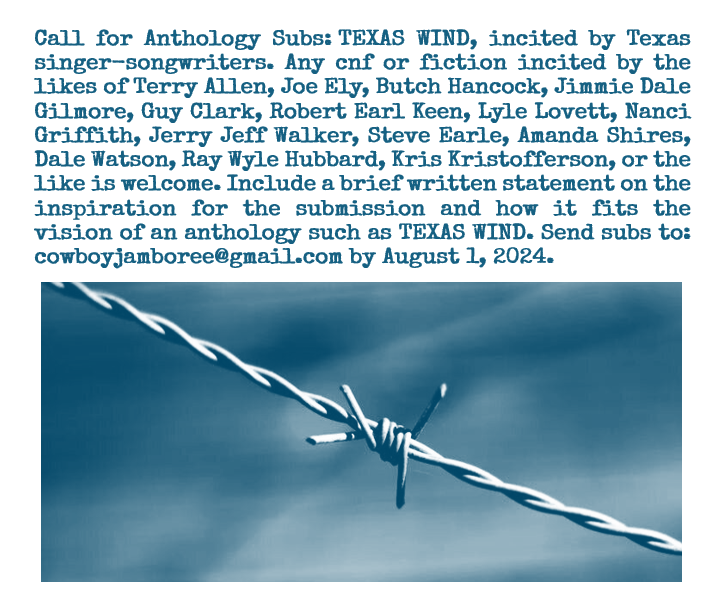
In addition to these two successes, I have two hopefuls out there — one “on submission,” as they say in the biz, and one I’ve just begun writing. I’ve already submitted “Pontiac” in response to Cowboy Jamboree Press’s call for an anthology to be called Texas Wind, intended to be a collection of creative nonfiction and fiction “incited” by Texas-based songwriters such as Guy Clark, Keen, Nanci Griffith, Jerry Jeff Walker, Steve Earle, and others. My story is based on Lyle Lovett’s song by the same name from his 1987 album of the same name (his second album). Here’s hoping! (If you’re writing and have something that might work for Texas Wind, submissions are supposed to be accepted up until August 1, 2024.)
The other hopeful will be — I have only a couple of ideas and a couple of paragraphs so far — submitted to the Bouchercon 2025 anthology call for submission. The meeting will take place in New Orleans, LA, so the stories should be set in or related to the Crescent City. I read a lot about that area in James Lee Burke‘s Dave Robicheaux novels, not that I’m going to do anything other than be inspired by Burke’s magnificent prose. Again, I have only a couple of paragraphs, which I like, but I haven’t found a story yet. I’m thinking about my Dr. John Riddle, Professor of English from Runion State University, who is in New Orleans for a literary conference. Something bad’s going to happen, I guess.
As you can tell from my experiences above, these are generally themed anthologies. They’re organized around a central idea or subject. For example, the call for submissions might be for an anthology of stories related to a particular place or a particular genre or a particular person and so on. And these are often the brainchildren of smaller presses — that is, not something the big publishing houses are interested in.
Here are some examples:
Let Me Say This: A Dolly Parton Poetry Anthology from my heroes at Madville Publishing. Here’s a bit about what’s inside: “54 poets’ takes on often-unsung facets of this diamond in a rhinestone world—calling in Dolly’s impeccable comedic timing, her lyric mastery, her business acumen, and her Dollyverse advocacy.”
Burning Down the House: Crime Fiction Incited by the Songs of the Talking Heads from Shotgun Honey. Here’s what’s inside and why: “A charity anthology to benefit the fight against climate change, . . . a dazzling exploration of what crime fiction can entail — deftly mixing grimy crime, small-town grit lit, literary noir, and tales that blend crime with speculative fiction, sci-fi, road trip comedy, magical realism, and horror.” Also from Shotgun Honey, Thicker Than Water, “tales featuring female protagonist who navigate the precarious boundaries of the darker spaces of humanity,” created and sold to support breast cancer research.
Motel: An Anthology, from the folks at Cowboy Jamboree Press. Several of my X friends have pieces in Motel. Here’s bit about what’s inside and why: “On lost, lonely highways, deep in the American heartlands and skirting the shady edges of cities, once ubiquitous motels have faded, some into ruin, others transformed from way station to permanent residence. MOTEL captures the heartbreak, desperation and indeed magic of motels.”
Bishop Rider Lives: An Anthology of Retribution and A Beast Without a Name: Crime Fiction Inspired by the Music of Steely Dan from the folks at Down & Out Books. Beau Johnson’s Bishop Rider lives again in the former: “The fifteen stories in this anthology both brand new tales and written by some of the biggest names working in crime fiction and horror today. . . . Come for the rage, stay for the dismemberment. See how a dead man makes them burn.” And in the latter, “These twelve tales interpret shady pasts, dubious presents, and doomed futures. There’s no hiding inside a hall of rock and sand from stories as deliciously wicked and terrifically twisty as the jazz-rock noir that inspired them.”
[Due to excessive commenting from Russian bots, I have stopped allowing comments on this blog. If you are not a Russian bot (or a bot of any other persuasion) and would like to comment, please email me at michaelamoscody@gmail.com.]
I don’t think “I Could Be the One” is among my best songs. I like the chorus really well, musically and lyrically, but I’m not wild about either the verses or the bridge. I wrote it back in the 1980s as one of my few attempts to write something commercial for Nashville.
I was rarely any good at such attempts.
Recently, however, in my expanded creative life writing fiction, I was able to borrow that good chorus from the song and use it in a short story that I also titled “I Could Be the One.”
Here’s the chorus as I revised it for the short story . . .
I could be the lover of your dreams I could be the stitch to bind your seams I could be strong when your strength is gone I could be the one When the nights are cold and you’re so blue You need somebody warm to hold on to Girl, don’t you run to no midnight sun I could be the one
I wrote the story in response to a call for contributions to an anthology that is likely to be pretty widely read, and I was blown away when I received the acceptance email. As Agatha Christie famously said, “Well, here’s to crime” (that’s a red herring).
I also made the story a prequel to my next novel, Streets of Nashville, which Madville Publishing will release on April 15, 2025. To learn a bit more about the process leading up to the contract for Streets, check out my query letter via the great Alex Kenna‘s blog that features samples of this important step in the publication process.
While I can’t say much more about the short story yet (contract pending), I’m terrifically excited about where it is ending up. I hope you’ll read it if you get a chance.
I have watched you be deceived by men with silver tongues Their pretty lies just go straight to you heart And I have wished it could be me that you run to in the night Oh, I would hold you and never let you fall apart
I could be the pleasure in your dreams I could be the stitch that binds your seems I could be strong when your strength is gone I could be the one
When you go to bed at night, do you lie awake and cry, Wondering why true love is so hard to find? If I had the nerve, girl, I would walk right up to you And let you know the love you’re looking for is mine
I could be the pleasure in your dreams I could be the stitch that binds your seems I could be strong when your strength is gone I could be the one
Some night in this lonely town I’m gonna be there when you turn around Maybe then you’ll finally see That I’m right on time with the love you need
I could be the pleasure in your dreams I could be the stitch that binds your seems I could be strong when your strength is gone I could be the one When the nights are long and you’re so blue And you need someone to hold on to Girl, don’t you run to no midnight sun I could be the one
P.S. Here’s the initial catalog entry for Streets of Nashville . . .
[Much of what is below was originally posted on September 6, 2023, but kind of a lot has happened since then! So, here’s the year-end edition.]
I did a lot of writing in 2023.
In January, I signed up for an online class on writing grit lit led by writer Sheldon Lee Compton. Three of us worked with Sheldon for a couple of weeks (maybe more). In the process, we wrote four pieces of what turned out to be flash fiction, each with a different focus; on one, for example, we were to create the piece (narrative, character, etc.) using mostly dialogue.
I titled my dialogue piece “Abyssinian Night.” Mystery Tribune picked it up for its online daily fiction archive back in April or May, I think. You can read it here if you’re interested. The story had at least one reader! My X (not ex-) writer-friend Casey Stegman wrote this and linked the story: “Another story this year that I enjoyed the hell out of is this one from @DrMacOde (published by the always amazing @MysteryTribune).” Remember Casey’s name!
One of our other assignments for that workshop was particularly focused on setting. I wrote a piece I titled “Holy City Buskers,” which was accepted for online publication by The Dead Mule School of Southern Literature. The story went live there in early December. You can read it here if you’re interested.
I wrote two other pieces from Sheldon’s grit lit workshop – “Bell-Eye” and “Penny and the Beast.” I submitted both a couple of times to no success before deciding not to send them out anymore. Instead, I’ll keep them for myself and make them available here when this site is revised (hopefully in the first part of 2024).
In late August, I completed what I think was my first more-or-less traditional short story since the publication of A Twilight Reel. For the longest time it went untitled, and I referred to it as “Something Unspeakable,” a working title taken from what was – again for the longest time – its opening phrase: “Something unspeakable now lives in our woods. . . .” Eventually, as the character and voice of the story developed, I adopted the title “Payne Mountain,” for the place where the majority of the story is set, a mountain above Runion named after the family living there as the story begins. With help from writing friends Tonja Matney Reynolds, Pat Hudson, and Chris McGinley, I refined the voice and finally finished the story, now out on submission at a handful of places. Here’s the first paragraph as a bit of a teaser:
That evening, half a century ago now, just after supper when we had moved out to the veranda to worship the last light, something unspeakable asserted an ear-shattering claim on our fifty acres of forested mountainside. What we heard began as a forlorn howl, such as some creature might make if it returned to its den to find the place and its little ones destroyed, a howl that escalated into a scream of rage. Its echoes spread invisible fire through the woods and sent us scrambling for our front door, imaginations terrorized.
from “Payne Mountain” by Michael Amos Cody
I spent the last quarter of 2022 and most of 2023 in the “querying” stage. (For those who don’t know, “querying” is the hopeful, humbling, humiliating, hopeful again act of writing to literary agents and publishers/editors to ask if they are interested in representing/publishing my work. The vast majority of these queries either go unanswered or answered briefly with a note that might be summarized in four words: “not-interested-good-luck.” But that’s the way it is for 99.9% of us who engage in this writing business. (For an example of this process, you might want to check out the September 5 episode of Writer’s Bone podcast with National Book Award winner Tess Gunty.)
I completed the first draft of this new novel, Streets of Nashville, late in the summer of 2022, aided by a week-long residency in Laurel Cabin at Wildacres in the North Carolina mountains. In the excitement of new creation, I prematurely submitted the novel to a few agents and publishers who (rightly?) rejected it. Since then, through the semesters of Fall 2022 and Spring 2023 and on into the summer, I revised the novel a dozen times, guided by helpful comments from a few friends, particularly my colleague Michael Briggs.
Here are the two main paragraphs of the query letter:
It’s 1989, and Nashville feels like a city on the knife edge of uncertainty. Violent crime escalates, even on hallowed Music Row. The city’s streets fill with strangers. Its music industry faces the death of traditional practices as the digital age looms. The anxiety of change cracks the façades of “Music City, U.S.A.” and “Athens of the South,” revealing an unacknowledged darkness.
In the early hours of Easter Sunday morning, gunfire echoes along 17th Avenue South when four people are shot. Tenderfoot songwriter Ezra MacRae—out on the town to celebrate the first good fortune he has had with his songs—witnesses the shooting, but the masked gunman spares him. But why? While Nashville Metro PD’s investigation progresses, the killer develops an obsession with Ezra—calling him, following him, haunting his dreams, but not eliminating him. Ezra tries to carry on with his songwriting, maintain his day job cleaning pools, and assist in the investigation as he can. When the seemingly methodical mind behind the Easter killings begins to unravel, the violence—including the threat to Ezra—escalates in Nashville and moves toward a final confrontation in an isolated farmhouse near Ezra’s hometown of Runion, in the North Carolina mountains.
Major Update: Here’s a surprising saga of success rising out of failure. As mentioned above, in the excited flush of new creation, I submitted what amounted to a first or second draft of Streets of Nashville to a few agents and publishers. One of the latter was Madville Publishing.
Original Madville submission was sent in the second or third week in September 2022.
After it was sent, I continued to learn more about my story and continued revising. Sometime in November or December, I received important feedback from my colleague Michael Briggs regarding one of most important and difficult relationships in the novel. I began to revise accordingly over the winter holidays.
On January 23, 2023, I received two things from Madville: 1) a pass on the novel, but which time my response was “of course and rightly so” and 2) some useful comments from Madville’s fiction reviewer.
I accepted the rejection and continued forward with revisions that were making the novel better and better (in my opinion, at least)
In May, I submitted the novel to a publisher I had really high hopes for and strong interest in, but even as I submitted the MS, I knew it was much longer than the publisher was interested in; still, the publisher remained interested in reviewing my work, so while I waited, I started an intensive mid-summer revision to reduce the word count from 106,000 (I think the original Madville submission was 92-96K words) to somewhere in the mid- to upper-80K range.
I think some miscommunication occurred between this desired publisher and me. When I wrote to say I was working on reducing the word count, the publisher—who still hadn’t rejected the novel—thought I was going to send the revision when completed. At the same time, I thought I was in the still-waiting-to-learn-if-you’re-interested stage. By the time this miscommunication got sorted and I sent the shortened manuscript in late September 2023, the publisher wasn’t going to be able to get to it until January, so I settled in to wait.
On October 12, my wife and I were taking part—as crawling audience members—in a Johnson City poetry pub crawl. On the walk between our second and third stop, I received an email from Madville (now some nine months after the rejection of Streets of Nashville). The initial email said that some old queries were being gone through, and mine looked interesting. Had they ever requested the manuscript? It just so happened that the acquisitions reader was looking for reading material. Before I could reply, I received an email apologizing for the confusion after the realization that they had, in fact, already seen and passed on my novel.
I went ahead and responded with this: “Yes, your reader responded to my first draft, which I submitted way before it was ready. The novel has gone through many revisions—guided by your reader’s comments and those of other beta readers—since September ’22, which I think is when I originally submitted it.” Only that and nothing more.
Here’s the next email I received a couple of minutes later: “My reader says he’d read it again if you want to send it.”
Reader, I resubmitted the manuscript the following morning, October 13, 2023.
On Friday evening, November 3, I was playing the season finale gig at the Barnett Patio. At some point, my phone vibrated in my pocket. I pulled it out and glanced at it and saw that I’d received an email from Madville. Figuring it was a closer-but-still-no-cigar note, I put the phone back in my pocket and played for my people. As soon as the gig ended, I had to hop in the car and drive two hours south to Union, South Carolina, to participate next morning in the Upcountry Literary Festival held at USC Union. I’d forgotten about the Madville email until I was in the drive-thru line at a McDonald’s just south of Hendersonville, NC. I placed my order as I rolled forward, I opened the email and read it carefully a few times. By the time I reached the pick-up window, I knew Streets of Nashville had found a home.
I have signed the contract. The completed manuscript is due to Madville by July 1, 2024, and Streets will hit the streets in early 2025.
During the year as I was revising Streets of Nashville, I spent significant time drafting a new novel with the working title Avalon Moon. This first draft currently stands at roughly 77,000 words (271 pages in typescript), and I think that I’m 5,000 words or thereabouts from typing THE END (which I actually never do). Back in the spring of 2023, I submitted the first fifty pages to a competition called the Claymore Award, which is associated with Killer Nashville International Writers’ Conference. In July, I learned that Avalon Moon had been selected as a Finalist for the Claymore in the category of Southern Gothic (it’s actually more Appalachian Gothic). While my submission wasn’t the ultimate winner in that category, I consider its achievement of Finalist status to be affirmation of the novel’s potential
I started the ball rolling with an Asheville company called The Talking Book to record an audiobook of my first novel Gabriel’s Songbook. Time and quiet recording space have been hard to come by, but I hope I’ll be able to do some—if not all—of the recording by the end of January 2024.
Another new thing I’ve done here at the very end of the year is write a couple of short stories specifically for proposed anthologies. The first—completed and submitted by the end of October—was for possible inclusion in the Bouchercon 2024anthology. The second—completed and submitted by the end of December—was for possible inclusion in an anthology based on the lyrics of Texas songwriter Robert Earl Keen. I really enjoyed writing these stories and have fingers and toes crossed for the success of each and both!
Who’s Gabriel Tanner, you ask? He’s the central figure of my first novel Gabriel’s Songbook.
The paperback cover from 2017
Yes, he’s fictional, but I know him pretty well. He’s a lot like me in some ways–all right, many ways. But in other ways I won’t go into here, he’s not. In addition to Gabriel’s Songbook, he’s featured in “A Fiddle and a Twilight Reel” from 2021’s A Twilight Reel: Stories. And you’ll probably not be surprised to learn that he’s a background character (but never “on stage”) in my new manuscript novel “Streets of Nashville,” as well as one of the featured narrators in my work-in-progress “Avalon Moon.” So, he’s been a busy guy.
I have a file that I keep on my fictional town of Runion and its people. The file includes dates all the way back to 1818. The note on Gabriel Tanner, whose first name seems to mean, in Hebrew, “devoted to God” or “hero of God,” was born to Kirk and Maggie James Tanner on March 8, 1959. He has a brother named Butler, a cousin named Carter “Cutter” Clements, and a wife named Eliza Garrison Tanner, to whom he has been married twice.
How did I pick March 8, 1959, as his birthdate? The 1959 comes from my interest in having him be roughly the same age I am, and I was born on November 25, 1958. More particularly, I picked March 8 because it was on that day in 1983 (I think) that I recorded “Thunder and Lightning” in Nashville. I was in Bullet Recording on Music Square West (17th Avenue South) with my producer Earl Richards and an amazing group of studio musicians. For several days, we’d been tracking songs for my second (unreleased) album, to be titled Waiting for the Night.
March 8 (a Tuesday in 1983) was the last day of laying down basic tracks for the album, and we had maybe two or three hours of studio and musician time remaining. So Earl asked if I had anything more that I wanted to record. “Well,” I said. “I have this new one that we could try.” (I said something like that. This was forty years ago today, you know, and I was twenty-four years old.) I played the song through once for the musicians, and they were ready to record. I doubt that it took more than a couple of takes to capture the track.
Oh, man, it was gonna be a hit! So said all who played on it and heard it. But it was not to be, as the album never saw the light of day.
Several years later, the “Cody Band” version of “Thunder and Lightning” made it on an Asheville, NC, radio station’s River Rock album and became a local–even regional–hit, making the list of top five requests of the day (alongside Prince, Madonna, and others) for several weeks in a row and subsequently picking up over one thousand plays between January and August.
The song was–and still is–terrifically important to me, so you can understand how its original recording date of March 8 would be assigned the birthdate of Gabriel Tanner.
If you’re reading this and you’ve ever worked with Leesa or sat in her chair, you know she will not do hair without music. Recently, we had to purchase a new MP3 player for her salon. I loaded it with some songs I had on hand, MP3s of favorites we’d purchased over the past few years. Along with those, I dumped whole jump drive of my songs on the new player, which she seems very happy about.
You know if you’ve seen me since – I don’t know – 2012, I have very little in the way of hair left on my head, and we’ve even begun buzzing that down to the scalp, just short of shaving it. Anyway, maintaining this requires that I sit down in her styling chair every 10-14 days. The last time I was there, a song came on that I had more or less forgotten. It’s called “Angel.”
I wrote the song in 1987 with Mark Chesshir, one of the lead guitarists in the band we typically called The Cody Band. Many of the songs recorded at Mark’s home studio over the years, especially those songs that don’t appear on either Cody Retrospective or Homecoming, Mark and I performed ourselves, playing all the parts or bringing in musical friends when needed or desired. I think “The Light in Your Eyes” and “I Must Have Dreamed” are good examples of this practice.
“Angel” includes the full band, I think. Mark Chesshir and Gene Ford on guitars, either Danny O’Lannerghty or Mark Burchfield on bass (can’t remember which), and Steve Grossman on drums. My guess is that Mark also played keys. I’m not sure why the song doesn’t appear on either of the albums mentioned above. If I’m remembering right, it was a powerful piece when we played it live.
I would feel the way I feel tonight forever if I could. My eyes are clear, my heart is strong, and love feels like it should. Still, the dawn cannot be held back, and this night will have an end. But as long as you stay, I know I’ll feel this way again.
O Angel, I know the sound of your wings. O Angel, I’m always listening for that whisper in the night.
When you hear me say, “I love you,” don’t feel trapped and run away. Sometimes when I look at you, I can find nothing else to say. I remember the nights that I have spent chasing ghosts and dreams. But you’re real to the touch, You don’t know how much that means.
O Angel, I know the sound of your wings. O Angel, I’m always listening for that whisper in the night.
I’ve seen so many broken hearts getting washed away at night. Come and carry me above that tide.
O Angel, I know the sound of your wings. O Angel, I’m always listening for that whisper in the night.
The front picture is of me as I looked when I wrote “Christmastime.” The performance is by me now, thirty-four years later.
As I recall . . .
It was in the spring of 1988, and I was writing songs for Ave Canora, a small publishing venture that was part of the music empire of Nashville/Broadway singing star Gary Morris. Word ran through the offices of Gary Morris Music that he would be recording a Christmas album in the near future. I’d never written a Christmas song before, but I really wanted to have a song on that album.
So, in April 1988, in the midst of that year’s Easter season, I sat down to write “Christmastime.” My main musical influences were only two: almost 30 years of hymns and carols in my little mountain church and community in Walnut, North Carolina, and Johnny Mathis’s album Merry Christmas, the Christmas album of all Christmas albums as far as I’m concerned, released in October 1958, less than two months before I was born. I was writing a lot of songs in the key of E at the time, and so, E it was for “Christmastime.”
Here’s an early recording of “Christmastime” from the home studio of my friend Mark Chesshir. It’s possible that this is the demo that I turned in to Ave Canora and the version that Gary heard.
Verse #1 is all about light, which is one of my true loves in the Christmas season. Leesa and I don’t decorate the exterior of our house, but I love the lights of Christmas. Light designs and displays–from simple to complex–are the only thing I enjoy about the extended Christmas season the Xian world developed due to the demands of capitalism.
See the world In a different light At Christmastime. See it shine In the children’s eyes At Christmastime. Let the season sparkle in me Like the moon on virgin snow Fallen some long-ago Christmastime.
We have light appearing in “shine” and “sparkle,” and we have “light” in its different connotation of understanding–to see the world in a different light. Many of us give the world a little more grace at Christmastime. Or maybe we express a little bit of righteous anger at the commercialism that isn’t as much in our faces as at other times of the year. With “virgin,” the lyric includes just a taste, an essence, a foreshadowing, of the Christian story of the birth of Jesus. And the “snow” is classic in terms of memory and desire, for me, as I’m always “dreaming of a white Christmas.”
Verse #2 is about memory. The older I get, the more precious and haunting memory becomes, perhaps especially in the context of Christmas. So much of the celebration and so many of the people I’ve celebrated with are yearly lost and fade into memory.
Window pane– Watching a parade Through frosty lines. Memories– Bittersweet and homemade– Cross my mind. Family and friends at the door– With the laughter and the kisses pour Love and good wishes for Christmastime.
This verse is made up of images from memory. These memories, however, are only implied. They’re left vague and general so that the listener (reader) can plug in their specific memories and memory images. I doubt if I thought that at the time I was writing this lyric, but it’s the way I understand it now.
Verse #3 returns to the Christmas story a bit more directly than the intimation of “virgin” in the first verse. We have a star and a child, a call for peace and stillness, a sounds of celebrating bells and singing people and angels.
Distant star, I am not alone With you in sight. In my heart, There’s a little child Alive tonight. So, let the world lie peaceful and still While the bells ring and people sing And angel wings are whispering, “It’s Christmastime.”
I hope that I got chills, that I maybe even cried, when I completed this last verse. It’s all there, I think, all that Christmas has been to me–all that I struggle to have it still be to me. The star that guided the wise men guides me to the child that is still alive in me. The moon on virgin snow exists as part of a world lying peaceful and still. The parade, the laughter, kisses, and good wishes are echoed in the ringing bells and the singing people. And at the end, the lyric returns one last time to the original Christmas story of angels–the “heavenly host”–appearing to the shepherds.
See the world In a different light At Christmastime. See it shine In the children’s eyes At Christmastime. Let the season sparkle in me Like the moon on virgin snow Fallen some long-ago Christmastime.
Window pane– Watching a parade Through frosty lines. Memories– Bittersweet and homemade– Cross my mind. Family and friends at the door– With the laughter and the kisses pour Love and good wishes for Christmastime.
Distant star, I am not alone With you in sight. In my heart, There’s a little child Alive tonight. So, let the world lie peaceful and still While the bells ring and people sing And angel wings are whispering, “It’s Christmastime.”
Many thanks to everybody who, over the years, has said that it’s not really Christmas until they’ve heard “Christmastime”!
“Merry Christmas to all!”
Here’s some more stuff:
I’ll go ahead and say it (with some regret and bitterness, and with apologies for the latter): I have a crass commercial desire that many singers had recorded “Christmastime” so that I could have a nice little royalty bonus every year . . . and so could Leesa when I’m gone . . . and so could Lane and Raleigh when Leesa’s gone. . . .
When I first moved to Johnson City, people used to say, “Hey, I heard ‘Christmas Time’ in K-Mart today!” I even heard it there a time or two myself. But, you know, K-Mart’s not around anymore. (There’s the bitterness again, and again, I apologize.)
Jimmy Patterson was a fellow I met years ago when Leesa, Raleigh, and I attended Cherokee United Methodist Church. He loved “Christmastime.” I heard it told that the first time I played it at Cherokee, Jimmy was standing with our pastor David Woody, and in his excitement over what he was hearing, Jimmy took Pastor Woody’s hand and squeezed it. I don’t know if that’s true, but I do know that “Christmastime” meant so much to Jimmy that his wife Bonnie asked me to play it at his funeral / celebration of life . . . in the summertime, as I recall.
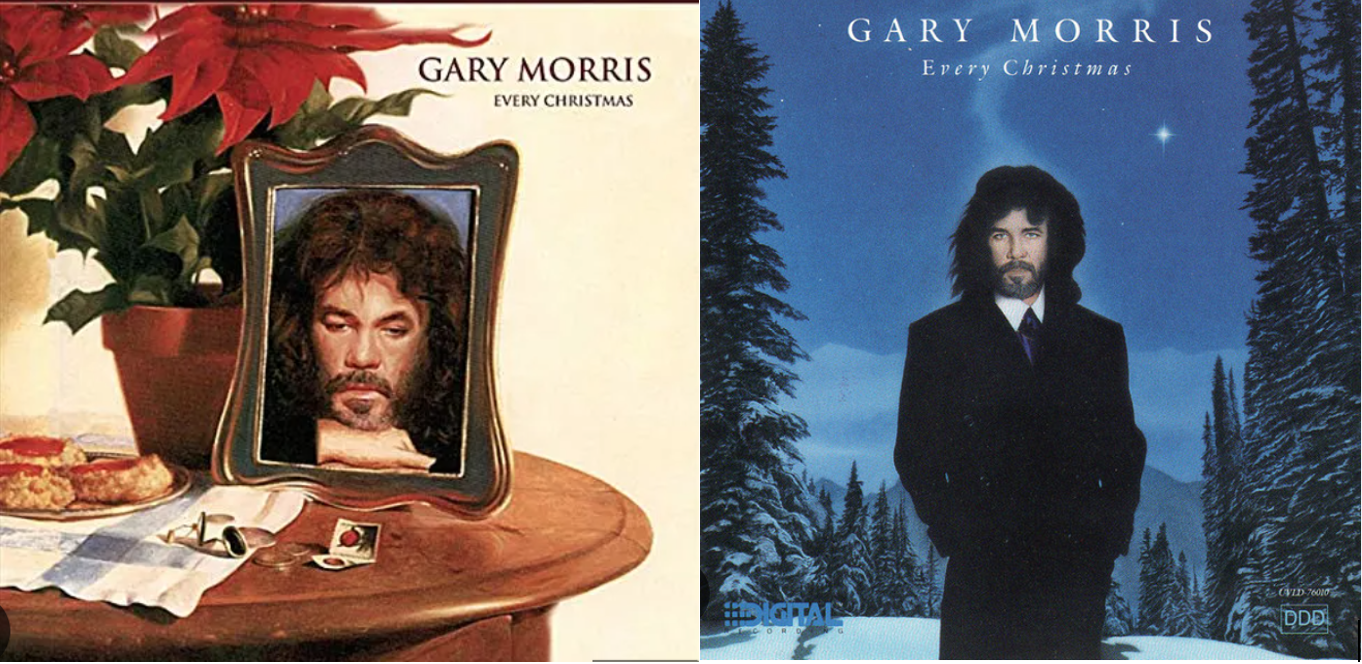
One last thing: Gary Morris released two different versions of his album Every Christmas.
I don’t remember exactly why this was the case, but here’s my story about it. He already had the original Every Christmas album recorded and turned in to Warner Brothers Records by the time I submitted “Christmastime.” That’s the cover on the left, released in 1988. The last song–track 10 on that one–was Gary’s version of “Carol of the Bells.” Then at some point soon afterwards, no later than Christmas 1990, they repackaged and rereleased the album–new cover (on the right) and “Christmastime” replaced “Carol of the Bells.” In practical terms, just as far as publishing goes, Gary’s company would receive what was called mechanical royalties for “Christmastime” that he wouldn’t receive for “Carol of the Bells.” I doubt that was the driving force behind the change, but it was a side effect. Now, on Gary’s website, the album on the left is for sale instead of the later “blue” version. Interestingly, the side effect here is that whoever gets the money for sales of that “poinsettia” version does not have to pay mechanical royalties to me because “Christmastime” isn’t on that version. Given this, I think it’s worth noticing that Spotify, iTunes, and other platforms sell only the “poinsettia” version, so . . . no Christmas royalties for me!
O the bells ring and people sing and angel wings are whispering, “It’s Christmastime”!
I enjoyed my writing life this year. Although the majority of my productivity has taken place, in confidence, between the right side of my brain and an array of hard and virtual drives, I got somethings out into the world.
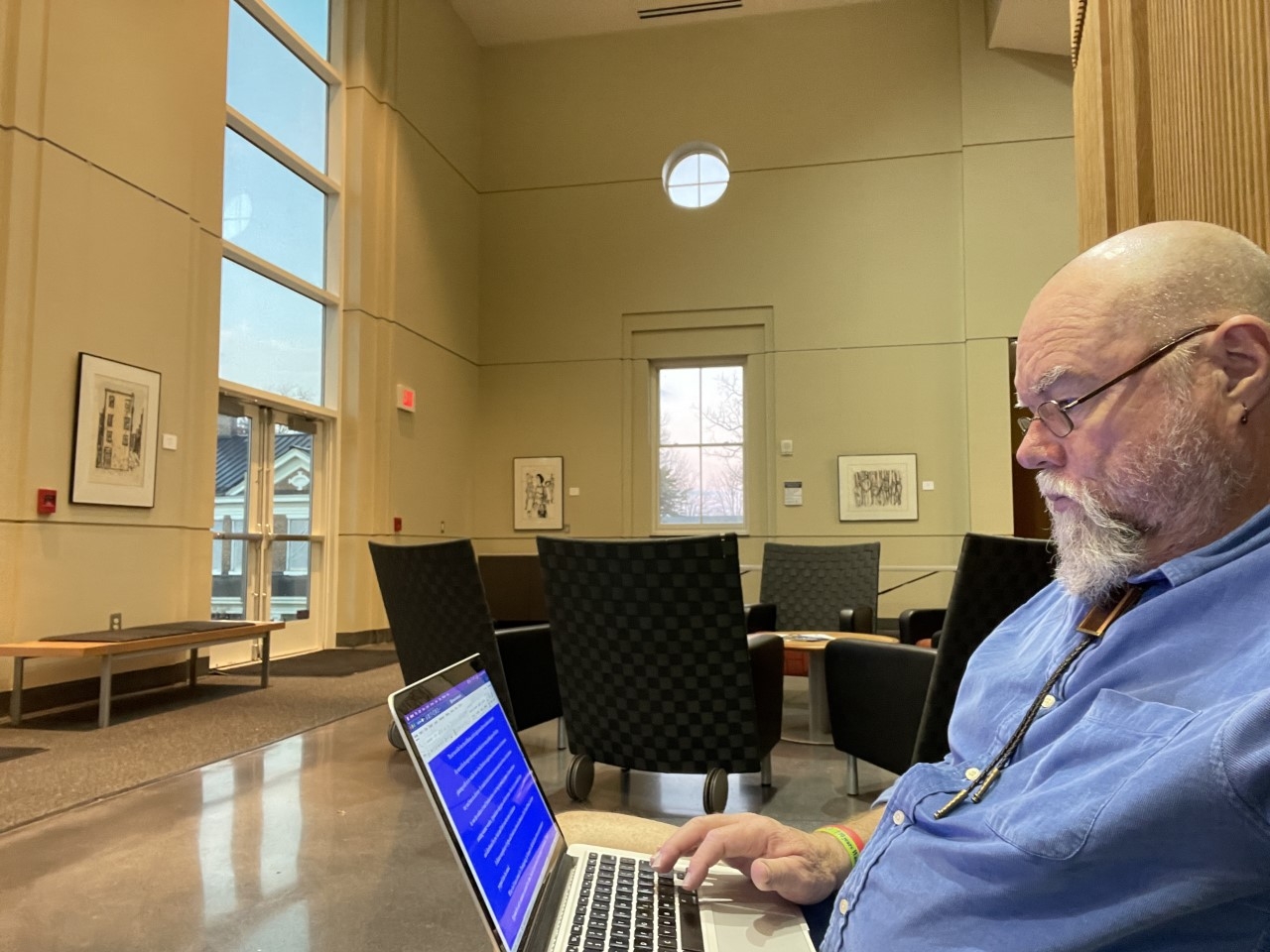
Leesa says when she sees the blue screen she knows what’s happening.
A number of blog posts. I set up a monthly schedule that’s I’ve more or less kept to. First Wednesdays are for writing/reading posts (like this one). Second Mondays are for whatever I feel like writing about. Third Saturdays are song stories. Fourth Tuesdays are supposed to be posts about politics, but I haven’t been very successful with these, as everything I think of seems to be darker and of meaner spirit than I want to be.
Short stories. I published one short story this year. “Jamboree” appeared in the Winter 2022 issue of my favorite online periodical Still: The Journal (#38). The good folks at Still included it among the journal’s Best of the Net nominations. The only other bit of news worth reporting about new stories is that I finally made some good progress toward finishing–but still not finishing–a story that I’ve been holding onto for years. It has been in progress and untitled for a good while, but I’m thinking now that it will be named something like “Payne Mountain.”
Gabriel’s Songbook (Pisgah Press 2017) is now five years old. Some folks have read it recently and really liked it, which makes me quite happy. I’ve done a number of podcast appearances to talk about A Twilight Reel, but Gabriel hasn’t gotten that kind of love. Until now. Back in September, Christy Alexander Hallberg interviewed me for her terrific podcast Rock Is Lit, which profiles “rock novels.” The episode “dropped” on December 8, and I’m really happy with it. The conversation about the novel was both good and fun, and I was really pleased with the follow-up discussion that Christy had with Frye Gaillard and Peter Cooper, the latter of whom walked on suddenly two days before, on December 6, from an accidental and traumatic head injury sustained a few days before.
At the beginning of 2022, I had a work-in-progress (WiP) about a Nashville songwriter named Ezra MacRae. I’m not sure how many words I had on it at that time. I’m thinking around 20K. I’m also not sure when I attached the working title, but I’m calling it Streets of Nashville until somebody with power tells me to call it something different.
Now that I think about it, I’m pretty sure I had that title before I submitted some pages of it for workshopping at Hindman Settlement School’s Appalachian Writers Workshop in July 2021. Most of my classmates in the workshop fell in love with a character Benny Jack, who was in a dire situation at the end of the section they read, which ended at what is now page 41 of the novel. Somebody suggested #SaveBennyJack, and the workshop folk carried on with that. [An interesting tidbit: much of the meeting-Benny-Jack section was written for Gabriel’s Songbook but got cut for reasons I won’t go into here. Suffice to say, Benny Jack exists much more comfortably–and much more effectively–within Streets of Nashville.]
By May 2022, I had somewhere between 20K and 30K words. On the 25th of the month, I was in Durham for my granddaughter’s graduation from high school, and the night before the ceremony, I was sitting in our AirBnB watching Wiley Cash interview one of my heroes, James Lee Burke, about Every Cloak Rolled in Blood, his 40th novel. Cash asked how Burke is so productive. Burke said he wakes up every morning–that’s every morning of the year except maybe Christmas–with a scene or two in mind. Then he writes at least 750 words on the scene(s), and by the end of a year, roughly, he has a novel. I decided I’d try that method for the following few weeks, and it worked for me. By the time I left on July 4 for my writing residency at Wildacres in the North Carolina mountains, I was approaching 70K words. Then, by the time I left Wildacres on July 10, I had completed a first draft of just over 90K words.
I’d proven to myself that I could write a book of fiction in less than twenty-five years! This was the amount of time that passed between first words and publication for both Gabriel’s Songbook and A Twilight Reel.
Between mid-July and now (approaching mid-December) I’ve made four more passes through the novel, the current draft of which is at 102K words.
All along, I’d been focused on trying to tell a good story. I’d thought it might be a mystery, but then I realized I didn’t know how to write a mystery. So, I just stuck with the good story idea. After the first draft was finished, I learned from Google that I had been writing a suspense novel:
suspense: the main character may become aware of danger only gradually. In a mystery, the reader is exposed to the same information as the detective, but in a suspense story, the reader is aware of things unknown to the protagonist. The reader sees the bad guy plant the bomb, and then suffers the suspense of wondering when or if it will explode.
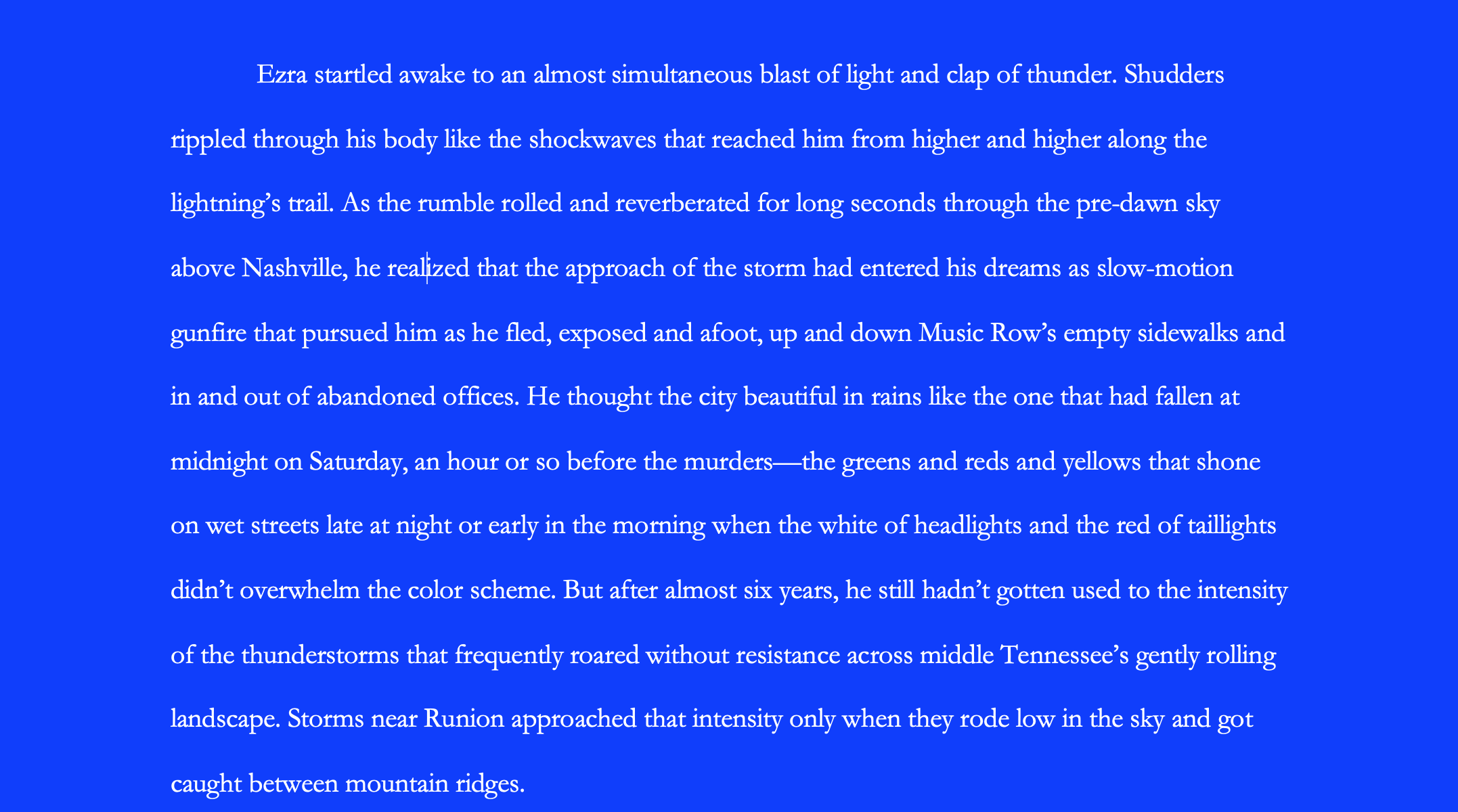
Just for fun, here’s what my writing screen looks like when I’m working. This is the opening paragraph of section VII.
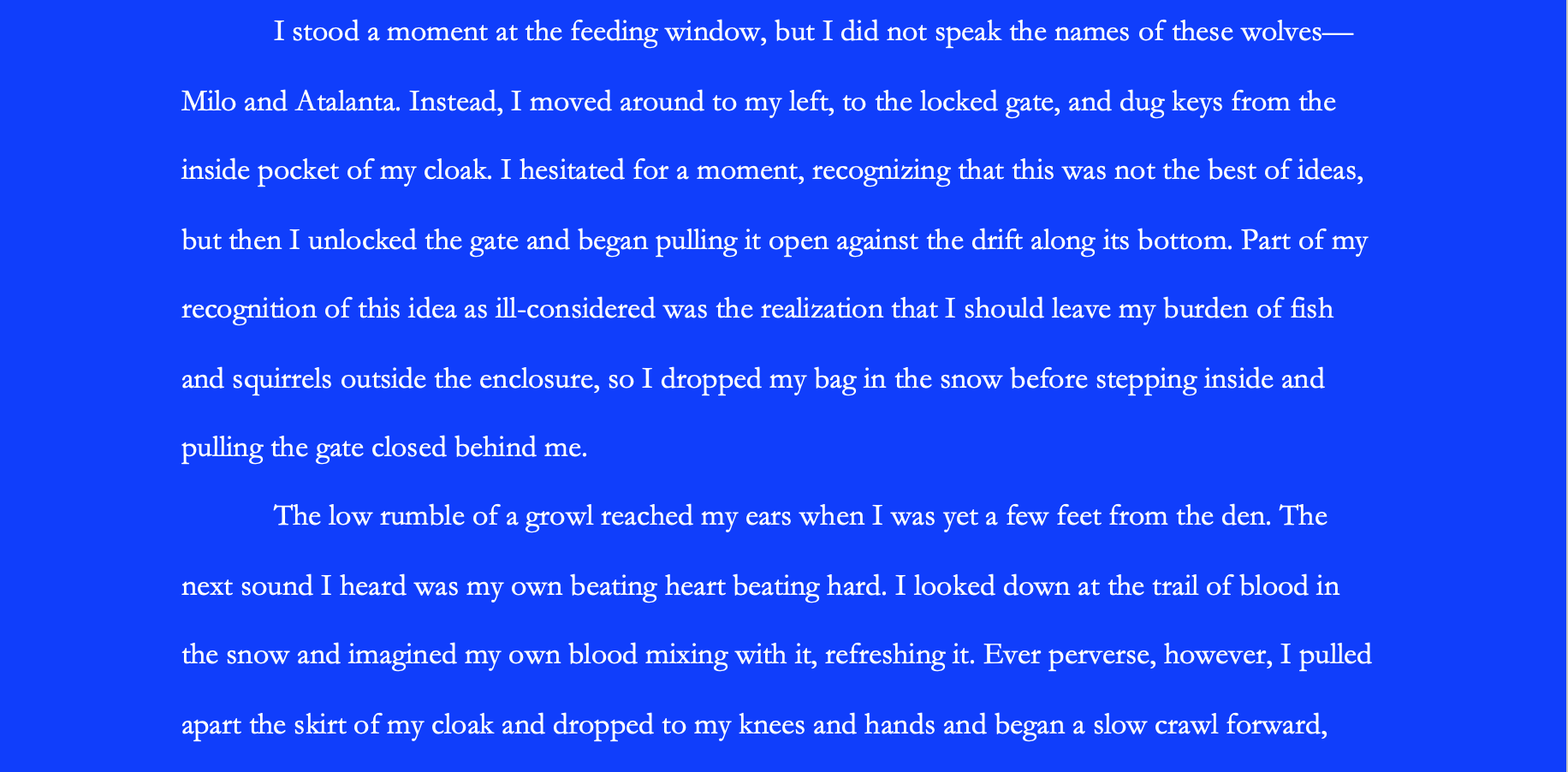
I started writing fiction in the early 1990s, using the old WordPerfect/DOS. I got used to the look replicated above. By the time my university offices began switching me to Word, I found I didn’t like writing in black letters on a white background. So, I figured out how to get my blue screen with my white or gray letters, and I was on my way.
I’ve sent Streets of Nashville to a couple of agents and a couple of publishers, but I think I’m going to put off going further with that process until after the first of the year. But a couple of folks have it in hand right now who could just blow me away if they said yes to representation and/or publication.
Avalon Moon
In the meantime, I have no time to sit on my nonexistent laurels, so, while I begin sending Streets of Nashville out into the world, I’m over 25K words into the next novel, which I’m calling Avalon Moon. I like where it’s going, and those who’ve read some of what I have seem to like where it’s going, too. I’m trying something different this time out, with a handful of different points of view, one of which is my old friend Gabriel Tanner. Like A Twilight Reel, this one hangs pretty close to Runion. The story will include wolves, a river island, preproduction work for an adaptation of a Ron Rash novel, a mysterious document over two hundred years old, and many of the Runion folks I’ve worked with before.